Communities
Over this past weekend, we saw some worrying headlines and conversations online about trans and cis people whose exploration of their gender identity involves detransition.
So let’s start with the reality: most people who transition do so without any regrets. Detransitioning is very rare, but it does happen. A research analysis showed that of the 3,398 trans patients who had appointments at an NHS Gender Identity Service between 2016 and 2017, less than one per cent said in those appointments that they had experienced transitioned-related regret, or had detransitioned. However, just because people have detransitioned it doesn’t make the experiences and existence of trans people any less valid or real.
Detransition does not in and of itself mean regret. It can mean that a person no longer identifies as trans or feel they are now a different gender to the one they previously identified as.
This is a discovery that may not have been able to come without taking the path they did. It’s also worth highlighting that some statistics out there that look at rates of regret focus on whether a person regrets a specific surgery – not whether they regret transition.
What we know from the research is that those acknowledgments of regret are actually most often related to unsatisfactory surgical results.
We also can’t forget that Gender Identity services in Britain are hugely under-supported and under-resourced. Waiting times for appointments at these clinics can be up to two years and patients can be forced to travel hundreds of miles to be seen. The lack of funding to ensure trans young people, and those who may be questioning their gender, are given the high-quality care and support they have a right to expect is a serious problem that needs to be addressed.
We need to understand and respect that the reasons why someone detransitions are often complex and nuanced – contrary to what some in the media and online may say.
The most common reason for detransition is the person couldn’t cope with the family and community support they lost and the experiences of transphobia. Where others may detransition because they are unable to find a job or housing.
We know from our research that one in seven trans people (14 per cent) aren’t open about who they are to anyone in their family, while one in four (25 per cent) were discriminated against when looking for a house or flat.
Just look at the story of Kate Hutchison, a trans woman who detransitioned for a period of time due to transphobia. As Kate writes: ‘The only time I saw visible trans people were when they were the focus of nasty jokes in the media or sensationalist headlines. I would get the same abuse in the street, and I saw no empathy or understanding in society as a whole for trans folks.’
Unfortunately, there are no statistics out there that show many people choose to retransition once they have more support structures in place.
So anyone who is concerned about detransitioning should be equally concerned with challenging the transphobia that is rife across our society. And we can’t treat detransition as the end of person’s journey in exploring their gender identity, as many will choose to retransition at a later point when they are safe and supported.
Every person, trans or not, should have the space and time to explore who they are, and have the support to do so. Where this happens, it allows people to be happy, healthy and feel included.
The policing of people who don’t conform to gender norms and stereotypes doesn’t just affect trans people. The demonisation of tomboys, butch lesbians and feminine gay men, is deeply harmful and shows the extent that misunderstanding these conversations around gender identity can affect us all.
We are working towards building a world where everyone feels comfortable and able to grow, change and be who they are without fear of discrimination or abuse.
At such a vital time for equality, we need to challenge myths and misconceptions about detransitioning, so we can change the way people think and feel about trans people.
Everyone who believes in equality needs to come together and be fierce, vocal allies for trans equality. Our work will not stop until every LGBT people is accepted – no exceptions.
Today, 20 November, is Trans Day of Remembrance, which was founded by Gwendolyn Ann Smith in 1999 to commemorate the life and death of Rita Hester, a black trans woman murdered in Boston, Massachusetts.
This year, there have been 331 known killings of trans people worldwide that Stonewall and other LGBTQ+ communities and organisations around the world will remember. Sadly, these numbers include the murder of Amy Griffiths, a 51 year old trans woman, in Droitwitch, Worcestershire, in January of this year.
On a global scale, some trans communities are more at risk of fatal violence than others. None more so than the trans community in Brazil, where the majority of killings of trans people have taken place in recent years.
The vast majority of those killed are trans women and transfeminine people of colour.
Every life taken has its own devastating circumstances but it is possible to observe that the vast majority of those killed are trans women and transfeminine people of colour. The Trans Murder Monitoring Project noted that, of those whose professions were known, 61% of murdered trans people this year worked as sex workers.
In Europe, the majority of murdered trans women were migrant trans women.
In Europe, the majority of murdered trans women were migrant trans women. Many murders of trans people occur in circumstances including poverty, racism, anti-immigrant and anti-sex worker sentiment and misogyny, which deprive some trans communities of resources and protection and make certain kinds of trans person especially vulnerable to male violence.
Sadly, some trans people – particularly women – are most at risk of fatal violence from cis male intimate partners, such as boyfriends. The stigma, family rejection, limited employment opportunities and social isolation experienced by many trans people can leave them particularly vulnerable to abuse in relationships.
Stonewall and YouGov’s research, LGBT in Britain: Home and Communities (2018), found that one in five trans people had experienced domestic abuse from a partner in the past year – including 16% of trans women.
As is the case for cisgender women, trans women in relationships with cisgender men are at highest risk of the most serious forms of violence. It is important to recognise that, for many trans women, the experience of intimate partner violence and domestic abuse is similar in nature to the kinds of domestic violence other women experience.
Violence against trans people is connected to a wider epidemic of violence against women.
Violence against trans people is connected to a wider epidemic of violence against women. It is why we're pleased that since 2018 there has been a commitment to trans inclusion in services providing support to survivors of domestic and sexual violence among the women’s sector in Wales, following a statement by women’s charities in Scotland in 2017.
In many cases, violence against trans people is also driven by toxic ideals of masculinity founded on homophobia and biphobia. On Trans Day of Remembrance, many of us, whether cis or trans, can reflect on how we can work together to end gender-based violence, harassment and discrimination in all their forms.
LGBTQ+ media and publications are a fantastic source of inspiring information that we owe so much to, however, rarely is the authentic bi experience reflected, despite bi people making up a substantial part of the LGBTQ+ community.
UNICORN, the new magazine from Bi Pride UK, is dedicated to celebrating and uplifting the voices of everyone in the bi umbrella (bi, bisexual, biromantic, pan, pansexual, panromantic, poly, polysexual, polyromantic, queer, fluid, heteroflexible, homoflexible, and anyone who experiences attraction beyond gender).
The content in the first issue is as diverse as you can get.
The content in the first issue is as diverse as you can get: photography, music, illustrations, animations, poetry, articles, opinion pieces, and a cover with a ridiculous amount of bi lighting involved.
The first issue is themed around ‘myth’. Artists from Central America, South Africa, and all over the UK took this theme and either made art with it, or talked about what ‘myth’ means to them. An incredible article from singer and producer Nalu talked about the myth of womanhood and exploring sexuality in LGBTQ+ RnB and hip hop. Blogger Finley explained the myths of being a gay transgender man, which talks about being bi also. Illustrator Bee Anderson offered up some awesome queer illustrations as well as a bespoke ‘myth’ piece. And so many more.
It's an epic article on the myth of being bi, and making awesome art along the way.
On the front cover is self-proclaimed ‘femme renaissance’ performer Victoria with her amazing cover story - it's an epic article on the myth of being bi, and making awesome art along the way.
Abigail Kay, Bi Pride UK Chair, “After breaking the record for the largest gathering of bi people at our inaugural Bi Pride UK event, I'm proud to say Bi Pride UK is making history again in launching the world’s first bi arts and culture magazine. It is a reflection of our wonderful community, full of talent, expression and dispelling myths about people who experience attraction beyond gender.”
Lev Alexander, Bi Pride UK Head of Media and Comms, “UNICORN is the magazine I wish I had growing up. A place of curiosity and intrigue, with amazing art to support it. Finally talking about bi people, from bi people.”
The digital magazine has been made with zero funding and each piece was donated to this community-run project. It will remain a non-profit entity supported by Bi Pride UK. Any profit generated from the digital magazine in the future will go straight back into the community through Bi Pride UK. As part of Bi Pride UK’s mission to support bi people with its Pride events, the organisation wants to to give them a space online to be visible and inspire others.
Read the first issue of UNICORN.
2020’s LGBT History Month theme is ‘Prose, Poetry and Plays’, the three pillars which frame what we understand as literature.
By delving into works created by LGBT writers, from the poet Sappho writing two and a half thousand years ago to the critically lauded ‘Burgerz’ by Travis Alabanza, we can broaden our understanding of LGBT history. For as long as there have been writers, there have been LGBT artists documenting their experiences. By learning about our history we can better comprehend where we are as a community today.
By learning about our history we can better comprehend where we are as a community today.
Literature created by LGBT writers acts as a gateway into understanding the landscape for LGBT people of the time, with so many authors forced to conceal queer characters between the lines. When their literature wasn’t written out of the canon altogether, their queerness so often was, rendering our comprehension of these texts limited.
This practice still happens today, with the lives of queer writers so often sanitised and diluted for students, as if LGBT lives are inappropriate for today’s youth, despite the LGBT experience being a large part of modern life.
Stonewall was founded in response to Section 28, an act that saw queer texts stolen from library shelves and with it LGBT role models lost for a generation.
However, the effects of Section 28 are still apparent in how we teach LGBT writers in our classrooms.
While the majority of his sonnets were aimed at an unnamed man, Shakespeare’s work is still encountered for the first time by young people without so much of an acknowledgement for who the majority of his sonnets were written for, suggesting to LGBT teenagers that their identity is something to mask, as if who they are is not appropriate for the classroom they inhabit.
By studying the plays of Oscar Wilde or the novels of Virginia Woolf without space afforded for their identity, we risk mimicking the oppressive society that forced writers to bury queer themes deep in the subtext.
In decades to come, we have an obligation to centre queer themes when examining the novels of Yrsa Daley-Ward and the poetry of Ocean Vuong, and when those works are taught, as I hope they will be, they will grant students an insight into the LGBT issues of our today.
Created by Schools Out, LGBT History Month is every February.
Stonewall works with primary schools, secondary schools and colleges to create LGBT inclusive settings. Read curriculum guides for primary and secondary schools.
First-of-its-kind research uncovers what life is like for LGBT young people not in education, employment or training
Bullying at school, discrimination in the workplace and lack of home support can have devastating impact on mental health and prevent LGBT young people from reaching their potential
Almost one in five LGBT people (18 per cent) looking for work have faced discrimination trying to get a job because of who they are
A new report by lesbian, gay, bi and trans equality charity Stonewall and BritainThinks – Shut Out –reveals for the first-time what life is like for LGBT young people who are not in education, employment or training (NEET).
The research shows that anti-LGBT bullying, lack of support at home or visible role models can have a devastating impact on LGBT young people’s mental health, and lead many to being ‘shut out’ of higher education and work. The report finds that once out of school and employment, LGBT young people are slipping through the gaps and face significant obstacles to re-entering education and work.
Through in-depth interviews and workshops, 30 LGBT young people were asked about their experiences of being not in education, training and employment, their mental health experiences and what would help them in the future.
Key findings show why these young people left education, training and employment, including:
- Experiences of familial rejection after coming out as LGBT
- Isolation at school and college due to anti-LGBT bullying and a lack of LGBT-specific support
- Negative experiences in the workplace, including anti-LGBT harassment
The report goes on to show that once out of education and employment, mental health struggles and difficulties accessing opportunities continue to hold LGBT young people back and prevent them from reaching their full potential.
Family relationships
The new report found that a breakdown in relationships with family, including rejection from family members due to being LGBT, was a key challenge for many LGBT young people.
Sean, a 24-year-old trans man from England, said: ‘My mum didn’t want me to transition, so I ended up moving into a hostel for a while.’
My mum didn’t want me to transition, so I ended up moving into a hostel for a while.'
Sean, 24
Previous research from Stonewall has found that only half of lesbian, gay and bi people (46 per cent) and trans people (47 per cent) feel able to be open about their sexual orientation or gender identity to everyone in their family.
Shut Out shows how difficult family relationships can leave LGBT young people without support, which can have a profound impact on their mental health and ability to stay in education or work.
Bullying in the classroom
Many of the young LGBT people interviewed expressed how experiences of bullying, coupled with a lack of support from teachers, led them to become disengaged from their education.
Aiden, a 21-year-old gay man from Scotland, said ‘At school, the bullying was really related to me being gay…I had to have a lot of time off when I was in school because of this discrimination. When I turned 18, I just stopped going.’
Stonewall’s School Report found that LGBT young people face troubling levels of isolation in Britain’s schools, nearly half of lesbian, gay, bi and trans pupils (45 per cent) – including 64 per cent of trans pupils – are bullied for being LGBT. Young LGBT people also face higher instances of mental health challenges, with two thirds of LGBT people aged 18-24 (68 per cent) experiencing depression in the last year.
The first time I experienced depression was when I was 14. I was young and in care, and I got feelings for a girl.
Adela, 23
The combination of these factors is preventing some LGBT young people from achieving their goals by shutting them out of education and limiting employment opportunities.
Adela, a 23 year old bi/pan woman from Wales said: ‘The first time I experienced depression was when I was 14. I was young and in care, and I got feelings for a girl.'
Mathew who is 21, gender-questioning and from Scotland said: ‘I was nervous about [leaving the house] because of the amount of times I’ve been bullied as a kid. I sometimes couldn't bring myself to leave my front door.’
Life after school
Leaving education to go to university or enter the workforce is a tricky transition for some LGBT young people. Of those that did go on to university, many felt forced to stop their studies due to unwelcoming environments which made their mental health worse.
Participants also shared their experiences of feeling forced to leave jobs because of anti-LGBT bullying, while some put off applying for positions as they feared they would be discriminated against. Stonewall research revealed that almost one in five LGBT people (18 per cent) looking for work have faced discrimination trying to get a job because of who they are.
He was anti-LGBT, and said that if any employees were gay, he’d fire them. So I left … I felt unsafe as an LGBT person.
Jamie, 19
Jamie, a 19-year-old non-binary person from England, spoke about their experience of being managed by someone who was openly homophobic: ‘He was a dodgy boss. He made me feel unsafe. He was anti-LGBT, and said that if any employees were gay, he’d fire them. So I left… I felt unsafe as an LGBT person.’
Barriers to re-entry
The LGBT young people interviewed described how challenging it was to re-enter education, employment and training once they had become shut out. A range of factors led to them being unable to get back into work or school, including poor mental and physical health.
The report also found that many of the young LGBT people lacked the practical support and knowledge they needed to find training opportunities and routes into work. As a result, the charity is calling for better mental health support for LGBT young people and specific careers guidance to help those that are shut out of education and employment.
Mo Wiltshire, Director of Education and Youth at Stonewall, said: ‘For the first time, this research sheds light on the challenges that young lesbian, gay, bi and trans people have faced, leading them to become shut out of education, employment or training.
Schools, colleges, local authorities and employers need to open their doors to LGBT young people, starting by creating environments in which everyone can thrive.
Mo Wiltshire, Stonewall Director of Education and Youth
‘This research has brought up many areas which we know present particular difficulty for LGBT people, such as bullying and a lack of support from their school days right through to the workplace. But now we can see that these challenges have lasting impacts, which is why it’s time to act.
‘Schools, colleges, local authorities and employers need to open their doors to LGBT young people, starting by creating environments in which everyone can thrive. No one should be shut out of education or work because they are LGBT, and we will keep fighting until every LGBT person has the support they need to be themselves and reach their full potential.’
8 March marks International Women's Day – ‘a global day celebrating the social, economic, cultural and political achievements of women’.
It has a clear purpose: to promote ‘unity, celebration, reflection, advocacy and action’.
Of course, we need more than just one day to celebrate all that women bring to the world, but the focus provided by International Women’s Day means we can draw attention to the inequalities faced by lesbians, bi women and trans (LBT+) people. We can use this day to not only acknowledge their many achievements, but to galvanise the momentum needed to ensure the LGBT movement – and society as a whole – grows more inclusive.
International Women's Day is an opportunity to hear from lesbians, bi women and trans people who have historically been silenced.
For us at Stonewall, International Women's Day is an opportunity to hear from lesbians, bi women and trans people who have historically been silenced. When we use our voices to highlight these injustices, and in particular, when we do so alongside our trans siblings, we empower one another. Working together, we can celebrate all of our identities and tackle the discrimination that affects each of us.
In Britain, people who identify as LBT+ disproportionately experience anxiety – 72 per cent of bi women and 60 per cent of lesbians experienced anxiety in the last year, compared with 56 per cent of bi men and 53 per cent of gay men. Trans people and lesbians in Britain are also more likely to report unequal treatment and lack of understanding by healthcare staff. Even in LGBT spaces, women are often excluded. 33 per cent of lesbians and 43 per cent of bi women in the UK say they ‘never attend LGBT-specific venues and events in [the] local community.’
The specific dangers faced by LBT+ communities can also be seen on a global scale. The Trans Murder Monitoring project recorded 2,982 murders of trans and gender-diverse people worldwide between 1 January and 30 September 2018 – with trans women of colour facing vastly disproportionate levels of violence.
Lesbians, bi women and trans people exist in a world that discriminates against us because of who we are and who we love.
Lesbians, bi women and trans people exist in a world that discriminates against us because of who we are and who we love. Plus, the combination of our gender identities and our sexual orientations means we often find ourselves at odds with the typical expectations around what it looks like or means to be ‘a woman’. Whether you’re a butch lesbian, a feminine bi woman with a boyfriend, or a trans person who changes how they express themselves day to day, we’re all at a higher risk of prejudice and harassment – no matter how we identify.
Because of this, we firmly believe that working for gender parity goes hand in hand with our fight for acceptance without exception for LGBT people. This International Women’s Day, we want to highlight the work of lesbian, bi women, and trans activists worldwide through our #OutOfTheMargins project.
Out of the Margins aims to address the specific needs, experiences and human rights violations of LBT+ people across the world. Since 2018, the project has brought together a global network of organisations working to advance and promote equal rights for LBT+ communities, using groundbreaking research and advocacy. Together, we’re fighting for a world where lesbians, bi women and trans people are fully included in their societies, and finally brought Out of the Margins.
We know that there is, and always has been, more that unites us than divides us.
We know that there is, and always has been, more that unites us than divides us. But only when we acknowledge the shared nature of our struggles can we work together to create a world where everyone is safe, supported, and free to be themselves. On this International Women’s Day, we urge our communities to come together in solidarity and begin taking the steps needed to make this a reality.
Please note: in light of COVID-19, this event has now been postponed. Please check Bi Pride's UK Twitter feed for further announcements.
At Stonewall, we loved attending the first-ever Bi Pride last year, so we're really excited to hear about the first Bi Pride Local in Swansea, in partnership with with Bi Cymru's BiFest 10-year anniversary.
Bi Pride UK has decided to give Wales that bi boost of positivity and celebration it deserves: it's teaming up with Bi Cymru to launch their flagship Bi Pride Local event, and celebrate the 10-year anniversary of BiFest.
Bi people continue to feel uncomfortable during other LGBTQ+ Prides.
Following last year’s success of the first-ever Bi Pride, 'the biggest bi gathering in history', Bi Pride UK concluded that events encouraging bi people to come together and celebrate their community are essential. Bi people continue to feel uncomfortable during other LGBTQ+ Prides. That's why the charity has decided to launch the first-ever Bi Pride Local event, partnering with Bi Cymru’s BiFest, and are striving to make 2020 even bigger and better for all individuals who fall under the bi umberella: bisexuals, biromantics, pansexuals, panromantics, polysexuals, polyromantics, homoflexibles, heteroflexibles and anyone else who experiences attraction beyond gender. Abigail and Ele are two of the organisers behind the event.
Abigail Kay, Bi Pride UK Chair, “I couldn’t be more excited about kicking off the first Bi Pride event of the year, in Wales. We’re honoured to be joining forces with Bi Cymru and celebrating a decade’s worth of BiFest celebrations, along with our very first Bi Pride Local event. I can’t wait to bring a wave of pink, purple, blue and yellow to Swansea!”
Ele Hicks, Bi Cymru, “We’re delighted to be working with Bi Pride UK to celebrate 10 years of BiFest Wales in May 2020. Bi Pride UK put on a great event last year and Bi Cymru are excited to collaborate to deliver a bigger, better, and free BiFest Cymru/Bi Pride Local for our 10th anniversary event."
A recent study showed that Wales is home to the largest number of bi people in the UK, with 8% stating they were attracted to more than one gender. It's surprising that, despite their large bi community, research by Stonewall shows that 3% of bi men in Wales had attempted to take their own life, and 34% of bi and lesbian women in Wales have experienced domestic abuse. HRC’s Foundation study of bi youths concluded that biphobia and sexual harassment affect bi people at a young age. 48% of bi people who've accessed the UK’s national healthcare services have experienced biphobic comments, and so two thirds felt they must identify as straight when receiving medical services, while 42% identified as gay, .
Bi Pride Local/Bi Fest will take place on Saturday 16 May at the YMCA in Swansea (1 The Kingsway, Swansea, SA1 5JQ). The whole event is set to run in two parts - a day event and a night event, with panels, talks, workshops, live music from bands and DJs, and a fully licensed bar with alcoholic and non-alcoholic drinks. Speakers and performers will be announced closer to the event. Visit Bi Cymru’s website for more information on the day event and the night event.
All individuals who experience attraction beyond gender deserve to celebrate their identities proudly and unashamedly, free from ridicule.
Events organised by Bi Pride UK and Bi Cymru aim to celebrate bi visibility, as all individuals who experience attraction beyond gender deserve to celebrate their identities proudly and unashamedly, free from ridicule.
There's no need to register online for this one, just turn up on the day, and give Swansea the big bi celebration it deserves!
Chances are if you’ve read a newspaper, gone on the internet, or turned on the TV at all, you’ve probably seen some shocking headlines about trans people lately.
The sad reality is that there a lot of myths and misconceptions being repeated over and over again, which makes it harder to get to the truth on these issues. Much of which has focused on debating reforms to Scotland’s gender recognition laws, known as the 2004 Gender Recognition Act (GRA).
So, let’s start by separating fact from fiction. The GRA is the law that governs how trans people can get their gender identity legally recognised on their birth certificate. The current system is secretive, treats being trans as a medical condition, costs a lot of money and takes several years to go through. The whole process is so traumatic and dehumanising that many trans people simply can’t face it.
Being able to get a birth certificate with the right gender on it matters.
But being able to get a birth certificate with the right gender on it matters. It helps make life admin easier, but mainly it means a trans person has a piece of paper showing the Government knows who they are.
The fact is, we know the majority of Scottish people support trans people and want to see a reformed GRA. The Scottish Government’s previous consultation found that two-thirds of Scots (65 per cent) support a system of self-determination. Putting such a system in place would be life-changing for so many trans people. Just like everyone else, trans people deserve to be respected for who they are.
This toxic conversation has amplified inaccurate information and makes trans people second guess whether it’s even safe to go out in public.
However, discussions about the GRA are being driven by misinformation and hate, pushed out by a few loud voices, to make reform feel ‘controversial’. You don’t have to look far to find story after story questioning who can use what bathroom or changing room in relation to updating the GRA. Not only do these stories misrepresent the law and lived experiences of trans people – as the 2010 Equality Act protects trans people in accessing single-sex spaces that match their gender – they have a serious real-world impact on trans people’s lives. This toxic conversation has amplified inaccurate information and makes trans people second guess whether it’s even safe to go out in public.
It’s trans people who will benefit from GRA reform and a simpler process of legal gender recognition. My experience in Ireland, where our Government introduced similar reform back in 2015, show these changes to the law are hugely positive for trans people, and have little to no impact on anyone who isn’t trans.
Visit our Trans Hub.
Celebrating Trans Day of Visibility without the constant vitriol aimed at the trans community for the first time in years is a strange experience.
It’s a breath of oxygen we needed. A moment where we’re not the target and we can live and be our authentic selves. It’s staggering to me that a global crisis, unprecedented in the modern world, had to be the catalyst for this cessation in hostilities.
Unfortunately, we can’t discuss the beauty and vitality of the trans community this year, without also touching on the pain and distress this crisis is causing trans communities. This is a difficult situation for everyone, we need to come together as a global community and show solidarity and love. Especially those of us in marginalised communities.
However, there are issues facing our community which are exacerbated by inaction and “debate” over recent years. Our healthcare systems are still complicated and put unnecessary hoops for trans people to jump through. Our system of legal gender recognition is overly bureaucratic and expensive.
Unfortunately, we can’t discuss the beauty and vitality of the trans community this year, without also touching on the pain and distress this crisis is causing trans communities.
In times of crises, these needlessly knotty systems can’t function and that leaves trans people to fend for themselves. The barriers we have to overcome, which for decades we’ve been told have been designed to protect us, now leave us in painful uncertainty.
Those of us who have spent years in the system trying to access the hormones and healthcare we desperately need may now face delays with an uncertain end. Indeed, as the NHS pivots to support those suffering with COVID-19, it’s unclear how, and for what period, these services will be impacted.
The NHS must move to look after COVID-19 patients. That’s not even a question. They are doing incredible work and I hope each and every one of us will remembers the personal risk taken by every NHS staff member at this time to keep us safe.
This Trans Day of Visibility I ask allies to my community to reach out. Reach out, make yourself available and show love.
My concern though is that due to overly complicated systems, created with little input from trans communities, our community is now experiencing huge levels of distress. Once this crisis has passed it’s time to simplify and humanise healthcare and legal processes so trans people can live to our full potential in British society.
This Trans Day of Visibility I ask allies to my community to reach out. While tweets of support and sharing of positive media is always appreciated, right now trans people, like many of us, are isolated. Trans people who have faced rejection from friends, family and neighbors are vulnerable. Trans people who rely on their local support group, who rely on that weekly, fortnightly or monthly face to face contact are vulnerable. Reach out, make yourself available and show love.
To trans communities, look after yourselves. If there’s anything the trans community is famous for it’s our ability to persevere. It’s sad that we’ve struggled, but I really feel our ability to overcome is something to take great pride in. We as a community have overcome, through kindness and understanding, for generations. This Trans Day of Visibility look after yourself. Practice self-care, and remember, now more than ever, it’s okay not to be okay.
We as a community have overcome, through kindness and understanding, for generations. This Trans Day of Visibility look after yourself.
My final word of advice to everyone this Trans Day of Visibility, while we’re all in isolation with brains full of worry and concern, read up on our history. I think we can all, trans and cis people, take some courage and comfort from reading the histories of the trans community at this time.
When I feel worried, I always take great strength from the people who built the foundations we work from today. I hope this Trans Day of Visibility you can too!
Like millions of people across the country, Stonewall staff are working from home for the foreseeable future.
We’re adapting to social distancing, but we’re not finding it easy!
Something we have found helpful is sharing with each other hints and tips about what’s keeping us busy, and what’s cheering us up, during this difficult and uncertain period.
So today we’re launching a new hashtag – #StayInForLGBT – and asking you to tell us how you’re spending your time while we’re all social distancing.
Here are some of our ideas to get you started:
1. Nick
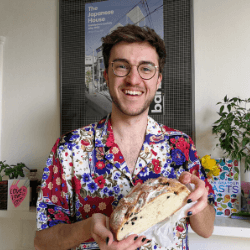
Nick said: ‘Baking has been a big comfort and source of mindfulness/self-care for me during isolation. It’s a non-screen-based activity, it takes up lots of time, it’s a creative output, it makes the flat smell great and it doesn’t matter if it goes wrong because it’s only you eating it!’
2. Jai
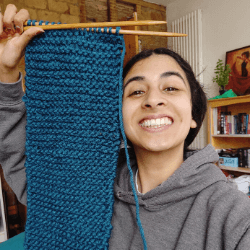
Jai said: ‘I've got a running Hangouts call with some friends while we WFH. I’m also helping out people in my community with my local mutual aid group, having cups of tea in the garden, rearranging my bookcases, and knitting!’
3. Adelaide
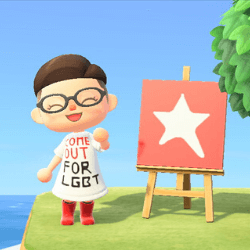
Adelaide said: ‘Like many people, I have been escaping into peaceful video games to take my mind off things. My little character on Animal Crossing makes sure everyone knows that her island is an LGBT-friendly space!’
4. Ez
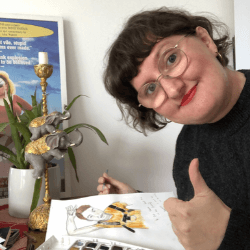
Ez said: ‘I have taken up doing watercolours of butches. I paint during the daily Government update. It’s a way to calm my mind as I process the information as well as helping me deal with how much I am missing all the butches from the Stonewall office.’
5. Yeme
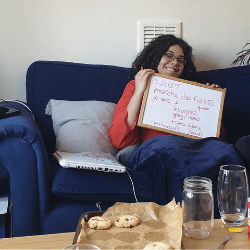
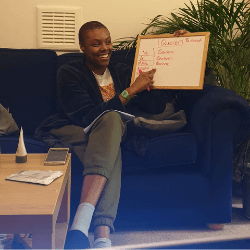
Yeme said: ‘We’ve been keeping busy by having skill swaps. Tajah is teaching Spanish, Mae is teaching French, I’m teaching German, and Tajah and Marcus are teaching sign language. I’ll be teaching some origami soon as well! I’m also moving away from the comfort of knitting scarves to basically knit everyone in the flat a hat, and maybe some gloves if I dare …
We’ve also been learning dances together. We were quite proud of our ‘All in this Together’ dance from High School Musical and we’re now tackling famous KPOP dances.’
6. Tom
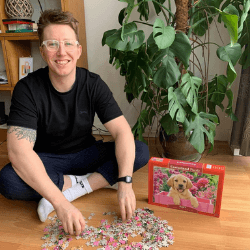
Tom said: ‘With the world on lockdown, losing myself in the simple joy of a puzzle helps me take my mind off things. This one has an adorable puppy on it, and is deceptively hard because of all the blurry foliage in the background.
Sometimes I put on a podcast to puzzle along to – I’m a big fan of the Reasons to be Cheerful podcast with Ed Miliband.’
7. Erin
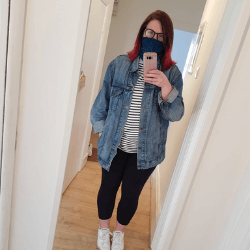
Erin said: ‘I have no plans to shave my head, but I did bleach my hair and then dye it pink. Here’s the evidence – along with a demonstration of the 90s lesbian classic bandana being used in a 2020 way. Perfect for daily walks.’
8. Max
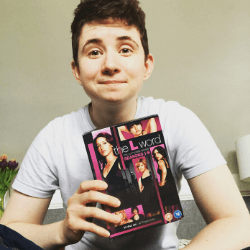
Max said: ‘Me and my flatmates have been dedicating (some of) our evenings to re-watching the L Word. It’s the perfect distraction – we’ve never needed to live vicariously through Shane more than we do now. I also learned how to use self-timer to take this photo, which is another new skill for me!’
9. Ted
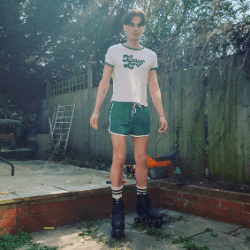
Ted said: ‘During isolation I have been filling my time by bedazzling everything, making beautiful food, and partying with my friends every Friday for Queer House Party. I also learnt how to roller-skate in the garden!’
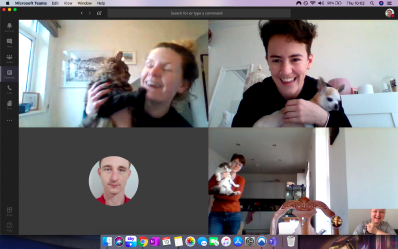
10. One final suggestion, from our Fundraising team: get your pets involved in meetings!