
Communities
The COVID-19 pandemic has affected every aspect of life, for everyone in our society.
We are all working and interacting with each other in a way that would have been unimaginable even weeks ago.
Like many other charities, restrictions on Stonewall’s activities and on our ability to raise funds has had a dramatic impact on our organisation.
To ensure Stonewall survives and can continue our vital work through and beyond this pandemic, we are furloughing just over 40% of our staff from this week. This means these members of the Stonewall team will be on temporary leave from work, but we can continue to pay them and keep their jobs in place with the support the Government is offering under its Job Retention Scheme. The Stonewall staff being furloughed work in areas where we are no longer able to continue with our normal activity during the current restrictions the Government have put in place for our safety.
Let me be absolutely clear: the need for our work has not disappeared. In fact LGBT communities, like other minority groups, face unique challenges over the coming weeks and months. That’s why we are ensuring our core services are still there for those who need them. We will still be providing online signposting and support, resources and direct support for teachers, parents and workplaces, and working with LGBT communities and groups throughout this time. Our work with politicians from all parties across the UK similarly continues, ensuring that the voices of our diverse community are heard right at the heart of all the governments across the UK as we find our way through this situation.
It’s a challenging time for all of us. But I know how strong our community is when we pull together, and there is no doubt in my mind that we will come through this stronger than ever. Donations to help us weather this storm are more valuable than they have ever been right now. Donate to help ensure we can keep supporting LGBT communities through this crisis and help rebuild as fast as possible.
Content warning: homophobia, hate crime. The author has asked to remain anonymous.
A few years ago, my wife and I were the intended victims of a neighbour’s pre-meditated but thwarted homophobic attack. Because of a variety of circumstances, we ended up isolating for three weeks whilst the police and others held an investigation.
It had been many years since I had come out, and over that time I had a long journey with my lesbian identity that has included reluctance, shame, intrigue, pride, confidence, and acceptance (not necessarily in that order!). By the time this incident happened, I’d settled into a nice place of self-acceptance and happy visibility. I was happily married, an LGBT network representative at work, and had spoken about my lesbian identity in various media outlets.
But because of the incident, I became all too aware of my identity in another way—it was my visibility as a lesbian that nearly led to physical harm. My ownership over my identity, and thus the visibility surrounding it, was taken away from me – I didn’t have control over how people, even those helping, saw me.
I didn’t want to be The Lesbian Who Escaped the Hate Crime. I wanted to go back to being my office’s LGBT Network role model, the woman who proudly wore her #LwiththeT shirt at Pride, and the team sport coach with the Rainbow Laces, creating a safe space for young players to come out. But that was not safe to do.
Facing new circumstances, my wife and I realised that the best way to regain this ownership – to be safe, at that moment, in the best way possible – was to support each other. In the very acts of loving each other, we were visible, even if only to each other. Even if she was only one who saw me cooking dinner, finding new shows on Netflix, sorting out paperwork, and being me, it was still impactful.
Facing new circumstances, my wife and I realised that the best way to regain this ownership – to be safe, at that moment, in the best way possible – was to support each other.
I realised something important during that time, something that has helped me a lot over the last few weeks: being visible varies. Visibility does not need to be a big public profile or social media post. Sometimes, in some crucial moments, being visible is simply to be. You are visible simply by existing – and that visibility is worth celebrating.
In whatever form it takes, positive visibility can bring huge benefits. Having visible role models in professional fields, entertainment, sport, politics gives us something to aim for. Knowing that other people have survived the same struggles you’re facing can be empowering.
And being celebrated for who you are is an amazing feeling. But all these benefits can only be accessed if there is safety. That’s why Lesbian Day of Visibility is so crucial this year: whilst we want to enjoy all the benefits of being visible as a community, we must be safe in doing so.
As the world battles Covid-19 and adjusts to the challenges it brings, many of us are finding our traditional ways of being visible impossible.
Prides and other community events have been cancelled. Sports clubs or theatre groups which may usually provide us with friendship and safe space cannot meet in person. University classes are cancelled, ripping many LGBT people from safe living spaces. Many LGBT people are isolating in households where it is unsafe to be themselves.
As the world battles Covid-19 and adjusts to the challenges it brings, many of us are finding our traditional ways of being visible impossible.
Visibility takes on a different meaning in these times. Visibility can be writing a blog post. It could also mean reading an article and taking in its points—but it doesn’t have to mean sharing it. Visibility can be checking in with friends.
Visibility can be reaching out to LGBT groups, joining a webinar, participating in online spaces, or accessing aid. It could be leading discussion groups, volunteering in your community, or donating. It could simply be self-care.
Visibility takes many forms. Whatever form it takes for you, your visibility, your pride, and your identity are still valid.
If you can, please donate to Stonewall so we can continue our vital work.
Nancy Kelley is the new Chief Executive of Stonewall, and will start working with us in June 2020.
She comes to us from the National Centre for Social Research (NatCen) where she was Deputy Chief Executive and Director of the Policy Research Centre. Throughout her 20-year career, Nancy has built up a diverse record of policy and leadership experience working across the third sector and in Government, including at the Department for Work and Pensions, Refugee Council and Barnardos.
She lives in London, with her wife and two young children as well as two naughty dogs.
Can you tell us a bit about your involvement in LGBT issues up to now?
I’ve not worked inside the LGBT+ sector before, so I’ve got a lot to learn from colleagues at Stonewall and our partner organisations – something I’m really looking forward to. I come from a broad social justice background.
I’ve worked across a range of sectors: mental health, children and young people, refugee rights, poverty and social exclusion.
So professionally LBGT+ issues have been a cross cutting theme: I’ve worked with LGBT+ young people, LGBT+ asylum seekers etc.
More recently, at NatCen I’ve done a lot of work on public attitudes, including public attitudes to LGBT people, as well as supporting research teams to think about approaches to collecting data about LGBT+ communities in a robust and respectful way.
What do you see as the biggest challenges facing the fight for LGBT rights at the moment?
Like other liberation movements (feminism I think is in a similar place) we are at a point where the gains the movement has made aren’t equally felt, or even aren’t equally relevant across our communities.
Some of us have benefited far more from progress in LGBT rights than others. So thinking about how we are genuinely intersectional in our approach, and how we campaign passionately and effectively for the things that matter to distinctive minoritized communities feels essential.
Secondly, it feels like we are simultaneously at a point of great potential and great danger for trans and non-binary people.
Visibility is growing exponentially, and research shows us that the population as a whole has broadly positive attitudes to trans folk: there is real potential for positive change.
But at the same time not only are there huge barriers to trans and non binary people living their lives safely, there are worrying noises coming from government and from the legal system that have the potential to push trans rights backwards.
Those are the issues that are top of my mind as I step into this new role – I’m looking forward to having lots of conversations with colleagues, partner organisations and supporters over the next weeks and months to shape our strategy for the coming years.
Taking up such an important new role in the middle of a pandemic must be challenging. How are you approaching it?
With compassion for myself, for the staff team, and for all the people we are working hard to support.
This isn’t home working, it’s surviving a pandemic, and I think it’s really important to remember that.
That said, there is lots of potential to learn from the way in which organisations and individuals are adapting right now - and every reason to believe that Stonewall will come through this experience stronger and more connected than ever.
Personally, I thrive on relationships so I'm trying to accept that the process of getting to know the Stonewall family might take a little longer and feel a little different than it would if we were meeting and talking face to face.
Above all, I feel incredibly excited and privileged to join this groundbreaking organisation and start working as part of the LGBT+ rights movement.
When did you first become aware of Stonewall and its work?
I can’t remember! I came to live in London in my mid 20s, and had friends who worked at Stonewall (I was a mental health worker, working for MIND), but I knew about the organisation well before I met them.
I can remember volunteering at a Stonewall party to celebrate equalisation of the age of consent. I spent most of the night shaking a bucket to raise money, and spent the end of the night in the VIP area chatting to Jimmy Somerville!
What is your favourite thing about Stonewall?
So many things – and I don’t even know the staff team yet! But it’s a fact that this organisation has made my life possible.
My wife is American, we can live here because of the Civil Partnerships Act. Even more, we have two sons, who are the absolute fulcrum around which I spin.
They’re adopted, because Stonewall made that into something that people like me (and you) can do.
The last few weeks have seen people of faith mark significant annual festivals.
The last few weeks have seen people of faith mark significant annual festivals. Pesach, Lent and Easter, Ramadan and Eid, and Beltane to name just a few. These are usually times for people to join together, to share food and worship, and to feel connected as a community. But this year, celebrations have had to change due to lockdown and restrictions on public meetings or visiting family.
As a member of Stonewall’s staff faith and belief network, I wanted to find out how other LGBT people of faith were managing lockdown and what was sustaining them. But I also discovered how their experiences have something to offer us all.
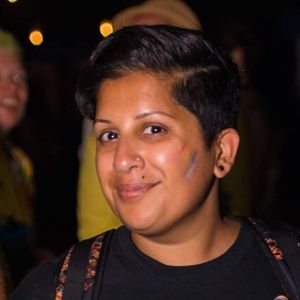
Farina
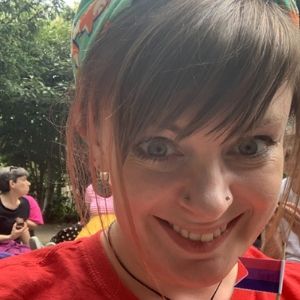
Kathryn
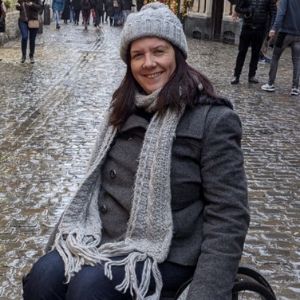
Naomi
What difference has lockdown made to how you practice your faith?
“I think that my faith is what's most been impacted by lockdown. Being a Jew is about being part of a community. It's very hard to be a Jew in isolation, without access to my typical routine of synagogue on Shabbat. Pesach was particularly hard, as I'm currently staying with my partner's family who aren't Jewish. While they would have been happy to have a proper Seder, it didn't feel the same and the week passed mostly unobserved.” (Sascha)
Church, which in the past I rarely felt brave enough to attend, is now coming to my home.
“Attending church has always been difficult for me, and often painful, as I have dealt with exclusion from churches not only as a queer Christian but as a disabled Christian too. In some ways, lockdown hasn’t changed much for me. In other ways, it has changed everything. My local church has been the one bright spot in this difficult time, while I’m completely self-isolating because I’m high risk. Church, which in the past I rarely felt brave enough to attend, is now coming to my home. No steps or closed doors bar the way to worship anymore. And being autistic during a streamed Sunday service is much easier than being in a physical church.” (Naomi)
“As a Pagan, community is very important to the way I celebrate, so being apart has been difficult. Celebrating Beltane via video call was odd, but seeing everyone in their houses, with candles instead of a fire, was quite special. Having a nature-based faith, and not being able to get out in nature is challenging. I am lucky to have access to a garden, to grow things and feel the seasonal shift. When it’s safe to do so, I’m looking forward to getting out into the hills, the woods, and lochs and sharing that with folk from my community, even if we have to keep two metres apart.” (Kathryn)
“Lockdown hasn't affected me personally as much in terms of how I worship, however it has made me seek more virtual connection than normal. What's been more challenging during Ramadan is not being able to move freely or to share experiences with fellow Muslims who may also be fasting. Eid is normally a time of being around family and friends, visiting one another's houses and eating a lot of food! So having to spend Eid alone, would have been very difficult for some.” (Farina)
What can LGBT people of faith offer to wider faith communities, or LGBT people, struggling with lockdown or isolation?
LGBT people of faith offer hope, a way to connect with God on a level that takes people away from lockdown.
“LGBT people of faith offer hope, a way to connect with God on a level that takes people away from lockdown and all it brings. We also offer spirituality and opportunities for people to take their mind off work, mental health stresses and any other restrictions they may be facing. I’m involved with [LGBT Muslim group] Hidayah, who have been offering a valuable online space during this time, including a virtual Iftar, film nights and an online informative session on the importance of Ramadan.” (Farina)
“I think LGBT people of faith offer perspective in how to handle difficult circumstances. I find solace in seeing faith groups organising food for NHS workers, and planning contributions to online Pride celebrations. There is strength in the intersectionality of LGBT people of faith, and the manifests in an openness and willingness to help our wider communities during this crisis.” (Kathryn)
We see a lot of misinformation and ‘debate’ about trans people. But actually when it comes to the data, it is clear. The majority of people, and specifically women, support trans rights.
As Stonewall’s new Chief Executive, and one with a penchant for data, I want to show you how the numbers – which show that most people, particularly women, are supportive of trans people - do not add up to the narrative we see in the media.
I will be using data from the British Social Attitudes (BSA) Survey, which is the highest quality available data on the general public’s views of LGBT+ people and relationships (full disclosure: I helped write and edit the report I’m referencing in a previous role).
The first thing to note from the BSA data is that the public do not like to see themselves as being transphobic – 83% say they are “not prejudiced at all” towards transgender people, compared with just 15% who describe themselves as “very” or “a little” prejudiced’’.
What does this tell us? Well – it tells us people don’t think being prejudiced against trans people is a desirable characteristic, and that proud transphobes are a minority group.
About half of us (49%) think prejudice against trans people is “always” wrong, compared with just 6% who feel it is “rarely” or “never” wrong. A third (34%) have more mixed feelings and say prejudice against trans people is only “mostly” or “sometimes” wrong.
So, the majority of us don’t want to be seen as transphobic, but when it comes to prejudice against trans people in our society we are less clear that it is always a bad thing.
A good example of how this plays out in practice can be seen in some older BSA data, where despite an overwhelming majority describing themselves as ‘not at all prejudiced’, just four in ten supported the idea that a suitably qualified trans person “definitely should” be employed as a police officer or primary school teacher (43% and 41% respectively).
And this isn’t a new phenomenon. In fact, what we can see happening for trans people now is very similar to how many people would have seen lesbians like me a few years back: we don’t hate you, but we don’t really want you teaching our children.
And while I’m using ‘us’ and ‘we’ here a lot here to talk about the British people, there are some really important differences in how people respond to these questions based on other things about them.
In line with other public attitudes (to lesbian and gay relationships, to abortion, to sex outside of marriage), some groups have more socially liberal views about trans people. Who are they? Well, younger people, non-religious people and people with higher level educational qualifications are all more likely to have positive views of trans people.
Oh, and women. Yes, women are more likely to have positive views of trans people. This is neatly illustrated in the earlier data, where 72% of women said that they were “very” or “quite comfortable” sharing a toilet with a trans woman, compared to 64% of men who were “very” or “quite comfortable” sharing toilets with trans men.
Let’s just sit with that one for a minute shall we? The current narrative of ‘women feel threatened by trans rights’ that is the cornerstone of anti-trans rights campaigns, simply doesn’t stack up with the evidence we have.
So, this is the bigger picture, backed up by solid data, that we are having these hard, heated and often deeply toxic conversations within. I also want to send my love to trans folk living in the UK right now who are seeing their existence and identity picked apart and debated across the national media.
It won’t take away the hurt, but I want trans people to know that the real picture is very different to what we are led to believe. The British public don’t like transphobia (even though sometimes members of the public can be transphobic), and half (49%) of the public feel that prejudice against transgender people is always wrong.
Despite the media narratives, misinformation and toxic debate which is making daily life harder and more gruelling for trans people – this evidence does shows that we are making progress. We can’t have equality unless it is equality for everyone, and we need trans allies to show up for our trans siblings now.
If you are in support of trans rights, please be loud and proud about it. While the Government has confirmed they won’t be rolling back trans rights, they will be announcing their plans for legal recognition for trans people over the ‘summer’.
So, it’s really important that MPs understand why supporting trans equality is important. You can help build support by contacting your MP this summer and asking them for a meeting to talk about trans equality.
Please call your MP’s office and ask for a meeting this summer. Together we keep up the pressure on the Government to support trans equality.
Today, the Equality and Human Rights Commission published a new report on public attitudes to trans people – drawing on data from the British Social Attitudes Survey.
At the moment, trans people’s lives are an almost constant part of our media narrative. But while the media can help reflect societal views and trends, it doesn’t give us a true impression of how people are thinking and feeling about things in real time. That’s why this data is so important.
So, what does it tell us?
Well, this data confirms a lot that we already knew. The first is that public attitudes to trans people are broadly positive. When asked about transphobia, we can see that transphobia is seen as ‘A Very Bad Thing’, and women, young people and people with higher educational qualifications are all more likely to feel positively towards trans folk.
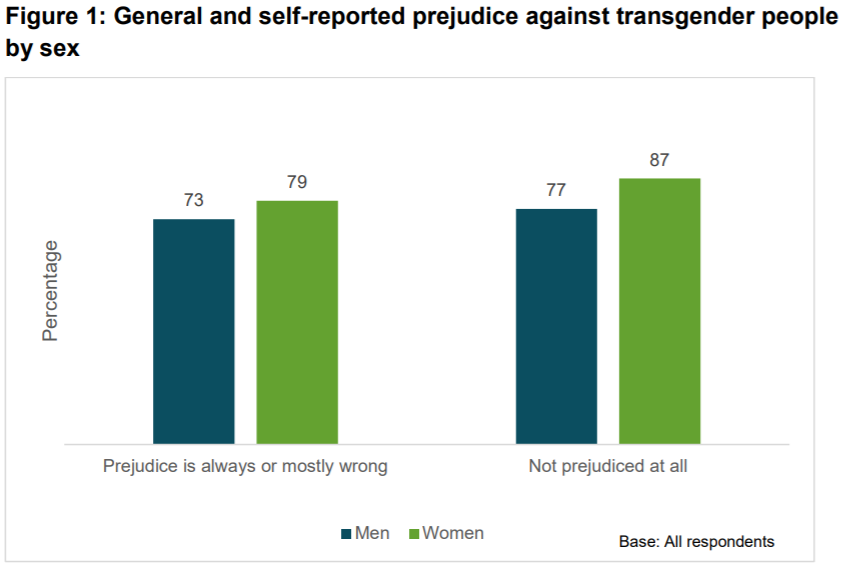
Secondly, high level attitudes appear not only positive, but also stable. This means that this positivity is not new, nor is it fragile. In 2017, 76% of people said that prejudice against transgender people was ‘always or mostly wrong’, compared to 76% in 2019 – so this has stayed consistent. While the proportion of people who describe themselves as ‘not prejudiced at all’ against trans people has risen, to 84% now, compared with 82% in 2016.
The proportion of people who describe themselves as ‘not prejudiced at all’ against trans people has risen.
Encouragingly, these positive attitudes hold up pretty well in real-life scenarios. The vast majority (84%) of people think properly qualified trans people should be able to work as police officers, and three quarters of us (75%) think trans people should be able to teach our children in school. This matters: these are the professions that the public sees as important and trustworthy, so accepting trans people into these roles is a great indicator of social acceptance.
However, there is some more concerning data, which suggests that in some areas, the public have become a little *less inclusive in recent years. While most of us, particularly women, continue to be comfortable with trans women using single-sex spaces like toilets and domestic abuse refuges, the data shows us a worrying downward trend.
The biggest change is in attitudes to trans women in refuges, where now just 51% of the population are comfortable (compared to 61% in 2016) and 24% are uncomfortable (compared to 16% in 2016). Contrary to common anti-trans narratives, these views are not driven by fear - only 1% of women are scared of trans people. So what we’re seeing is that the incessant and largely negative media coverage on these issues is likely starting to negatively impact and influence people’s attitudes.
If that’s what we *think, how do we *feel ?
So we know that a very small percentage of people fear trans people. But other than fear, how do the public feel about trans people?
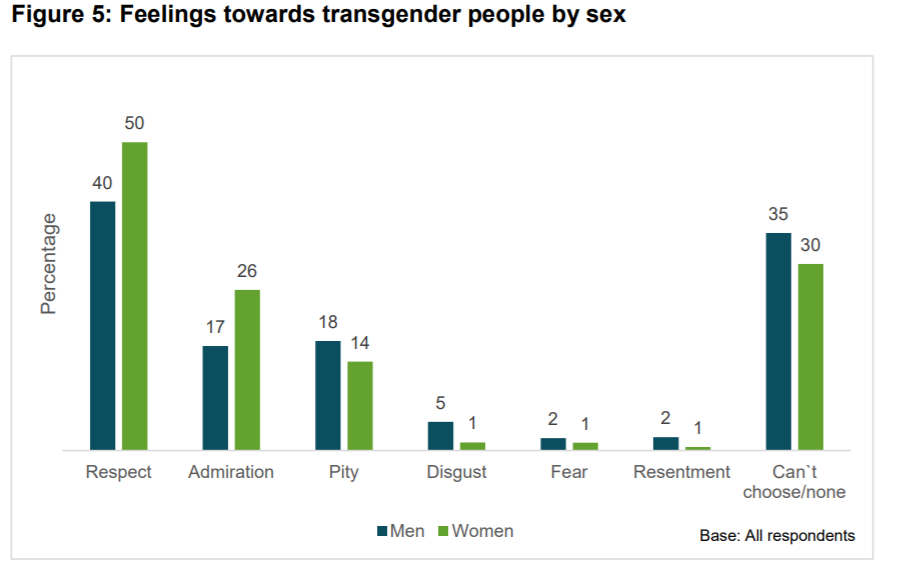
When the public is asked to choose words that describe their *feelings towards trans people, we see a really striking picture.
Overall, positive feelings dominate, particularly for women – half of us feel ‘respect’ and more than a quarter ‘admiration’ for trans people. We can also see that women are much more likely to feel respect and admiration for trans people, while also being less likely to feel disgust, pity, fear or resentment. This is important to bear in mind, as it undermines the common narrative which seeks to turns cis women and trans women against each other.
Positive feelings dominate, particularly for women.
But alongside these positive feelings, quite a lot of us aren’t sure and that’s OK. Some of these people may not be comfortable expressing negative feelings, many of these people are likely to be those who genuinely don’t know how they feel, or simply see trans people as ... people.
Very few people indeed selected negative feelings such as disgust, fear or resentment. But when we look at the views of the minority who describe themselves as prejudiced (16% of us), this transphobic minority feels very strongly: a third said they felt disgust (33%) and one-quarter said that they felt resentment (25%). This means that while the group of people who are transphobic, and would describe themselves as such isn’t large – 16% is in line with other forms of discriminatory attitudes to oppressed groups – the views of that minority are much stronger.
What does this all mean?
Firstly, this data demonstrates *yet again* that the public ‘debate’ on trans rights and trans lives is not in line with public attitudes. The British public in general, and British women in particular, feel pretty positive about trans people. If our media coverage and social media discussions simply reflected this reality, the lives of trans people would be immeasurably improved overnight. Instead of this, the drip, drip of negative and distorted media coverage may be manufacturing a creeping sense of discomfort around shared spaces.
And secondly, it shows that we have a small, but vocal group of people with extreme anti-trans views in Britain, and that should worry us all.
The Government Equalities Office estimates that there are between 200,000 and 500,000 trans people in the UK, in a population of more than 66 million. We need to make sure our trans family, friends and neighbours feel safe and welcome, and we need to hold family and community members, leaders and journalists to account for how they engage with the trans community.
If the majority of us simply sit by while the transphobic minority shout their harmful views from the rooftops, our warm feelings mean nothing, and we are part of a problem that is ruining trans folks lives.
If you see people sharing misinformation about trans people, challenge it.
Now is the time to act. If you’ve not done this already, call, email or meet with your MP and explain to them the importance of legal recognition for trans people. If you see people sharing misinformation about trans people, challenge it. And if you see abuse on social media, report it. We know that the public feel positively about trans people, now it’s time for trans people to feel it too.
‘We need, in every community, a group of angelic troublemakers’ – Bayard Rustin
CW: asylum, mental health.
Today is Bi Visibility Day and we've asked Vaneet Mehta, a bi activist, to tell us what it means to him. This year, Vaneet's hashtag #BisexualMenExist trended worldwide and helped countless people see themselves reflected in society.
Today is Bi Visibility Day, a day that has been celebrated since 1999. This is a day to recognise bisexual history, celebrate the bisexual community, and talk about the issues and experiences that bisexual people face. While bisexual people have come a long way since 1999, there are numerous issues that still persist, issues that are rarely highlighted or discussed within the LGBTQ+ community.
According to Stonewall’s statistics, when looking at LGB people, bisexual people are more likely to experience anxiety, self-harm and suicidal thoughts when compared to their gay and lesbian counterparts. In every category, bisexual women were worse off by a fair margin. And these findings are replicated in numerous other studies in other countries, too.
Bisexual people experience both the homophobia that gay and lesbian people face, along with biphobia.
This disparity between different groups in our LGBTQ+ community often isn’t talked about but it is important that it is, as it shows the specific impact that biphobia has on bisexual people’s lives. Bisexual people experience both the homophobia that gay and lesbian people face, along with biphobia. And when they experience discrimination, there are fewer places for them to turn to.
The LGBTQ+ community often isn’t a safe space for bisexual people. Historically speaking, bisexual people were often shunned from these spaces. For example, the London Lesbian and Gay Centre banned bisexual groups from using the space. But this isn’t just a historical issue. According to Stonewall’s statistics, 27 per cent of bi women and 18 per cent of bi men noted the discrimination they faced within their local LGBTQ+ community because of their sexual orientation. This is compared to just 9 per cent of lesbians and 4 per cent of gay men.
This is likely to factor into why 50 per cent of bi men and 43 per cent of bi women stated that they never attend LGBTQ+ specific venues and events, compared to 33 per cent of lesbians and 27 per cent of gay men. The safety in these spaces just isn’t there; they aren’t made for bisexual people.
Bisexual people noted this and started creating their own spaces, and there are a ton of great spaces online and in person for bisexual people. The Bisexual Index, Bi Survivors Network, Biscuit, London Bisexual Meet-up, Bi Pride UK, Bi Community News, BiCon, to name a few. But then a new issue arises: funding. There are reports in the US that show that, despite bisexual people making up roughly half of the LGBTQ+ community, less than 1 per cent of funding goes to spaces specifically made for bisexual people.
While the climate has improved for bisexual people, we still see the same topics arising again and again. ‘Bisexual people are transphobic’, despite the fact that bisexual doesn’t mean attraction to cis men and cis women but simply attraction to more than one gender, inclusive of all gender identities. ‘Bisexual people are cheaters’, simply because our attraction goes beyond a single gender. ‘Bisexual people are secretly gay/straight’, perpetuating the idea that bisexuality is just a phase.
I have had my sexuality questioned, both in person and online, from outside and inside the LGBTQ+ community.
These are all things I have seen online, constantly. I have had my sexuality questioned, both in person and online, from outside and inside the LGBTQ+ community. I have been asked how I know I’m bisexual, had my dating and sexual history quizzed, and asked which gender I prefer like they’re trying to gauge my ‘true’ sexuality. It becomes exhausting and frustrating to deal with. I spent so long questioning my own sexuality and now I have finally come out, I have everyone else questioning me instead.
We experience constant discrimination, are robbed of our spaces and are denied our existence. And yet people still believe that bisexual people have it easier. They think of bisexuality as a duality, a combination of gay and straight. They believe that our partial straightness gives us a level of privilege, but as all these statistics (as well as many others) show, this couldn’t be further from the case.
But this issue is so prevalent, it can even lead to death. Due to these stereotypes around bisexuality, bisexual asylum seekers are less likely to be granted asylum in the UK. There is this idea that if the person in question is capable of hiding their same-sex attraction in any form, they can return home and live out a safe existence. But in fact, they are sent home to their deaths. This fundamental lack of understanding on bisexuality puts lives at risk, especially for bisexual people of colour.
I spend a significant amount of my time within the community trying to educate people on bisexuality. I try to use my platform to dispel the myths and create awareness on the struggles we face. I do my best to support bisexual people, creating visibility in any way I can. This year, my hashtag #BisexualMenExist trended worldwide and helped countless people see themselves reflected in society. I’m hoping that my book on bisexual men, along with the T-shirts I helped create, will amplify this further. There’s a lot of work that needs to be done, but to ask bisexual people to do all of it isn’t good enough.
Those who claim to be allies to the LGBTQ+ community need to interrogate which members they are helping and how.
It is time for change. Those who claim to be allies to the LGBTQ+ community need to interrogate which members they are helping and how. Other members of the LGBTQ+ community outside the B need to show solidarity to their bisexual siblings.
Bisexual people need help, support and resources to continue to help some of the most vulnerable people in our community. Bisexuality is not a phase. For many, it is their end point. For others, who knows? Sexuality is a spectrum, it is fluid, it’s free, and it is time we embrace and accept that.
Vaneet's book 'Bisexual Men Exist' is out now!
Visit our Bi Hub.
Only one in five bi people (20 per cent) are out to all their family compared to three in five gay men and lesbians (63 per cent)
Two in five bi people (42 per cent) hide or disguise their sexual orientation at work for fear of discrimination
Research gives insight into the unique experience of bi people
Stonewall, the UK’s leading charity for lesbian, gay, bi and trans equality, has released new research that shows bi people are significantly less likely to be out than gay men and lesbians, whether that’s at home, in education, at work, or as part of a faith community. The study also reveals the impact bi-erasure and biphobia has on health and well-being of bi communities.
Bi people are three times less likely than gay men and lesbians to be out to all of their family.
The report, based on YouGov polling of over 5,000 people, of whom 1,769 identified as bi, reveals that bi people are three times less likely than gay men and lesbians to be out to all of their family (20 per cent compared to 63 per cent). While one third of bi people (33 per cent) aren’t open about their sexual orientation with any of their family.
The research also found that while two in five gay and lesbian people (44 per cent) are out to everyone at their educational institution, only one in five bi people say the same (23 per cent). Meanwhile, two in five bi people (42 per cent) have hidden or disguised that they were bi at work for fear of discrimination.
Bi people are often a forgotten part of the LGBT acronym.
Bi people are often a forgotten part of the LGBT acronym and can face ‘’double discrimination’: not only do they face abuse from straight people, but also from lesbian and gay people.
As one respondent to Stonewall’s Bi Report said: ‘Being bisexual means finding yourself excluded by gay people and straight people in social settings. I only tell my friends about my sexuality, meaning it is hidden from my family and my work colleagues. Bisexuality is a hidden sexuality through people’s lack of acceptance.’ Kendra, 32 (Scotland)
Stonewall research further shows how experiences of biphobic discrimination and rejection from family and friends significantly increase the risk of poor mental health for bi people. Nearly three in five bi people (59 per cent) reported experienced depression, compared to just under half of gay and lesbian people (46 per cent). Meanwhile, over one in four bi people (26 per cent) reported self-harming compared to one in ten gay and lesbian people (11 per cent).
Nancy Kelley, Stonewall’s Chief Executive, said: ‘For the first time we have research specifically looking at what life is like for bi people in Britain. What we’ve found is that across the board biphobic stereotypes and prejudices are making life harder for bi people and, too often, their experiences of discrimination are either undermined or ignored altogether.
‘This stops bi people in our communities from feeling able to share really important parts of their lives with those around them, hurts their mental health and gets in the way of them accessing appropriate help and support when they need it.
‘We all need to learn more about the issues bi people face, and work harder to make sure they are welcome and supported in our schools, workplaces, and communities. It is down to all of us to tackle ignorance about bi identities, and to challenge the damaging bi-erasure and biphobia that bi people of all ages experience.
‘We want every LGBT person to thrive and be confident about who they are. Accepting bi people without exception is essential to creating a world where everyone, everywhere is free to be themselves.’
This year the acute discrimination Black people face has been brought to the forefront.
Black LGBT people have been severely affected by the global pandemic, as well as the trauma of systemic racism, homophobia, biphobia, and transphobia experienced by the entire community. Now more than ever, we need allies to step up and take action.
We know that many people have looked to find ways to support the Black community during this time of immense pain and uncertainty. Sometimes this allyship can be positive and other times it can be misguided. Allyship is not a single step, it is an ongoing journey. It takes work, self-reflection and making that conscious decision over and over to step up until it becomes embedded in how we behave.
This Black History Month, some of Stonewall’s Black LGBT staff have discussed the most effective ways to be an active ally to Black LGBT people.
1. Listen to us
The last year has provided some much needed opportunities for Black LGBT people to be heard in spaces where they have been traditionally silenced or overlooked.
It's so important that your first step as an ally is to listen to and believe us when we tell you what we’ve experienced. Trying to ‘explain away’ racism is harmful and makes you complicit in upholding a racist system. Listen even when it is difficult to hear. It’s a lot harder for Black LGBT people to be open about their experiences. No matter how well-intentioned you thought you were, understand and accept when you have made a mistake.
It is also important that you do not take one Black LGBT person’s story as the only story. This risks allies treating us as one homogenous group. In fact, the Black LGBT community has a vast array of identities and experiences that must be recognised.
2. Do not ask Black LGBT people something you can learn yourself
We need you to listen to us, but we do not always have to be the ones supporting your education. Repeatedly explaining the realities of racism, homophobia, biphobia, and transphobia by people who actually experience it, is exhausting.
This blog and the resources on our Black History Month hub are only the beginning of your journey. There are so many great anti-racism resources that you can read and begin to learn from and grow a greater understanding and empathy for the challenges Black LGBT people face. Make sure this reading takes an intersectional approach to our experiences and are written by Black people. We would encourage you to build on this learning through discussions with other allies, so you can learn from each other.
It’s not Black LGBT people’s responsibility to relive our trauma or justify our existence. Rather than place emotional labour on your Black LGBT friends, educate yourself.
3. Recognise and use your privilege
The reality is that society is set up to benefit some people more than others. When you benefit from a certain structure or environment, you have a privilege. White people, cis people and straight people are inherently advantaged in certain ways by how society is structured, despite their own efforts, income, or background.
Acknowledging your privilege does not mean you have not worked for what you have or experienced hardship. It simply means that you have not been discriminated against due to certain aspects of your identity.
Once you can acknowledge your privilege, no matter how uncomfortable it makes you, you can use it to centre and amplify the experiences of others who may not have been afforded the same advantages as you. This can be giving up a seat on a panel to someone with a particularly underrepresented identity, or using the fact that people listen to you in meetings to insist on input from marginalised communities. It is important to consider this in all areas of your life as this will look different for everyone.
4. Speak up
Once you have done your research, you need to use your platform to speak up about the experiences of Black LGBT people. It is not enough for Black people to call things out, we need allies to speak up too.
Use your platform to educate others. Make sure you do not use your platform to speak over Black LGBT people or take credit for their work. Rather than take up space, centre Black LGBT people in the conversation. Amplify Black voices by directly sharing information created by Black LGBT people.
Be careful not to be performative in your allyship. Do not just speak up when our experiences are ‘trending’, make sure to keep up the momentum.
5. Your allyship is not inclusive if it does not include Black trans people
The lives of Black trans people were painfully overlooked this year in the Black Lives Matter movement – and always have been. This fails to highlight the higher levels of discrimination and violence that Black trans people face compared to Black cis people.
Being an ally to Black LGBT people means understanding the experiences of Black trans people in how their oppression is compounded by being Black and trans, and speaking out against transphobia.
Where you are able, support fundraisers for Black trans people’s transistions and housing needs. Black trans people suffer disproportionately from unemployment, pushing many into poverty, precarious housing situations and limiting access to essential healthcare.
6. Call it what it is. Anti-blackness
It is important to understand that racism impacts different races in different ways. Anti-blackness is a specific kind of racial prejudice towards Black people. It is inherently rooted in colonialism, the legacy of slavery, and eugenics.
Racist attempts to 'rank' races in order of value or worthiness have consistently placed Black people at the bottom, leading to a normalisation of anti-black across many cultures. While non-black people of colour often experience racism, anti-blackness can still be rampant in those communities that have a history of perceiving themselves as superior to Black people.
By acknowledging that the experiences Black LGBT people face are anti-black, and that racial discrimination can disproportionately affect Black people, we can take a step towards dismantling white supremacy.
7. Use the right language
Terms such as BAME (Black, Asian and minority ethnic) and PoC (people of colour) offer a limited and simplified understanding of race, often holding white people as the norm, and maintaining a eurocentric view of the world. They can suggest a homogenised experience for all people who aren’t white, when this is a dangerous oversimplification of reality. Within these communities, colourism and misogynoir are common experiences, and it's important to acknowledge that there are varying experiences caused by differing levels of privilege across these communities. Acknowledging and discussing uniquely Black experiences as those specific to the community, allows us to understand the particular steps and actions we need to take to drive forward tangible change.
If you find yourself needing to describe an individual’s race or ethnicity, and you know that they describe themselves as Black, Latinx or Brown – to name but a few – always use those terms rather than contentious umbrella terms.
8. Showcase Black LGBT people
We cannot overstate the importance of seeing yourself in positions of power in areas like the workplace, media, and education. It is validating, inspiring, and proves that people who look like you can achieve success in those areas.
In your workplaces, consider making D&I targets that do not just cover BAME, but also Black people explicitly. Not only are you supporting Black LGBT people in employment, but having our perspectives in decision making rooms only benefits your projects and external outputs. In fact, Forbes found in 2017 that diverse teams make better decisions in the workplace 87% of the time. However, in your effort to include Black LGBT people, take care not to fall into tokenistic practices. For instance, do not recruit Black people to positions of power but retain the authority or simply use them to excuse your organisation’s own racist and discriminatory behaviour.
The importance of Black LGBT representation in the media is vital, but it is important to consider who is creating the content. So often stories about Black people and Black LGBT people are full of hurtful stereotypes and misconceptions where Black LGBT people are reduced to only parts of their identity. Consider the opportunities you have access to, which perhaps Black LGBT creators cannot access, and how you share them. If you can’t tell Black LGBT stories right, then let Black LGBT people tell them.
9. Create spaces that are inclusive of Black LGBT people
Too often Black LGBT people must access spaces, especially LGBT spaces that claim to be safe, that perpetuate anti-blackness. Challenge racism vocally and ensure that your spaces do not perpetuate barriers to inclusion for Black LGBT people. Think about the touchpoints and obstacles where you are. Do they prevent people from accessing that space?
10. Support Black-owned businesses and fundraisers
Many Black LGBT people are simply not afforded the same opportunities as white people, and can suffer numerous inequalities in areas of housing, employment, healthcare, and education to name a few.
By supporting Black-owned businesses as part of your day-to-day purchases, you can support the community and help to begin to bridge these gaps.
For a lot of Black businesses likely to be smaller with less access to funding, supporting them will not only better them financially but provide opportunities to employ more Black people, provide more access to specific services that Black people need, and uplift the community.
The Black LGBT community have done so many incredible things this year, from raising money for amazing projects and organisations, to individuals going above and beyond to raise awareness and support the community.
This Black History Month, we wanted to spotlight five incredible individuals and organisations who are doing ground-breaking work this year to support the Black LGBT community. Find out more about their work and see how you can get involved and support them.
1. BAME Fundraising Virtual Conference
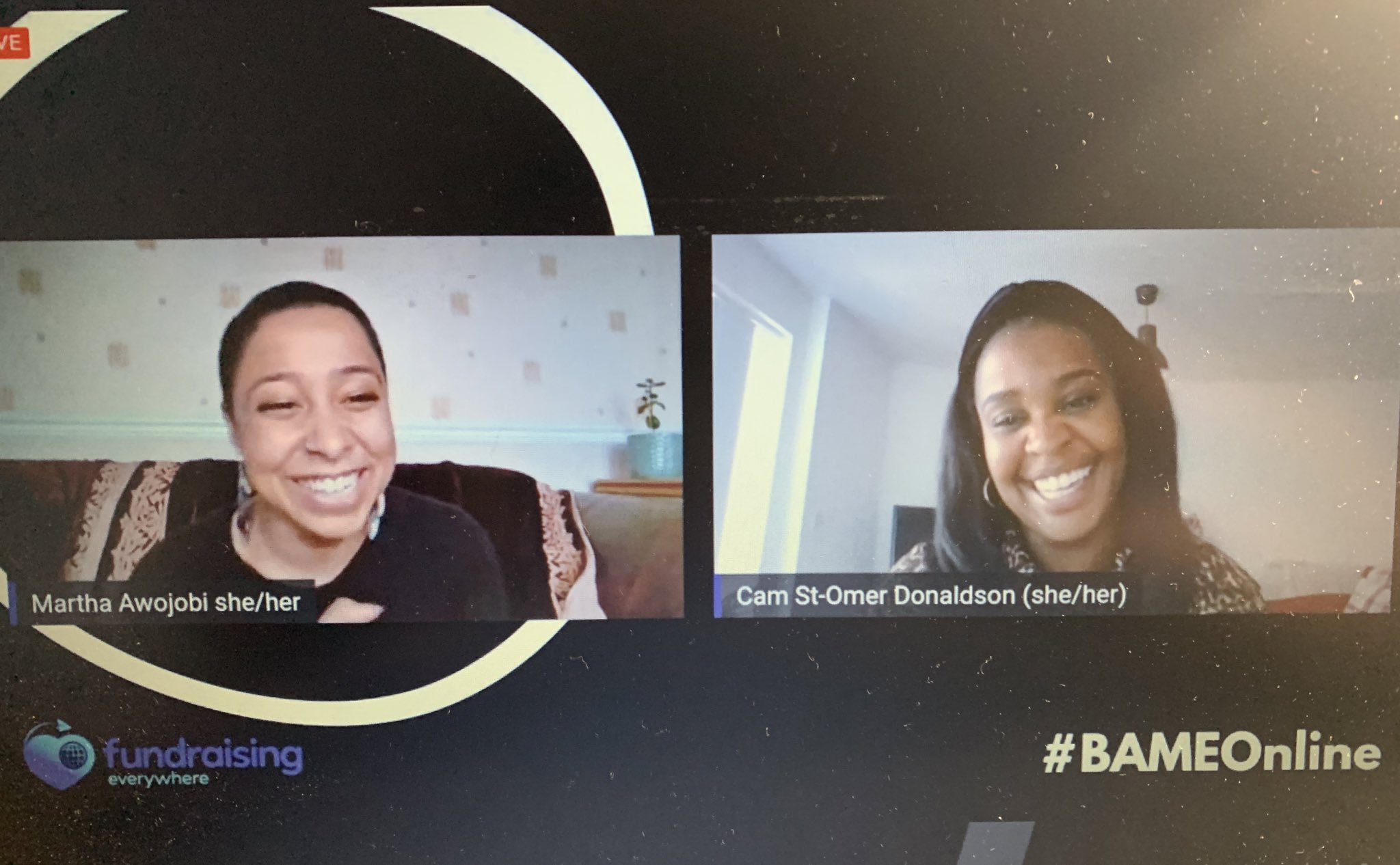
Martha Awojobi (she/her) is a consultant, writer and campaigner. Through her involvement in Charity So White and anti-racism work at her consultancy firm JMB, she aims to tackle institutional racism in organisations and supports them to be open about racism and find ways to recruit and retain BAME talent.
In July 2020, Martha put on one of the most groundbreaking and needed conversations on being a person of colour in the fundraising sector, a traditionally white-dominated space. With sessions like 'Ethical Copywriting and Imagery' and 'Building Resilience Through Innovation and Entrepreneurship', the conference empowered so many attendees to think about what it means for them to be in or consider joining and transforming the fundraising charity sector. In Martha’s words, the conference was ‘unapologetically black’, with more than half the speakers being Black, which really showcased what the community can do and why it’s so important to include us
The PoC staff network at Stonewall funded several our staff of colour to join the session and they had this to say about this event:
“It allowed me to visualise myself in a career that, frankly, the charity landscape told me I could not access. It described fundraising through a lens that made sense to me as a black person, and honestly inspired me to consider a career change if the right job came up” - Tajah
See more information about the virtual conference.
2. Black Trans Foundation
Azekel Axelle Nasah (they/them) is a Black queer non-binary activist based in Leeds and London who works to create community spaces that foster an environment of safety and acceptance for communities including Black trans people, QTIPOC people and Black women in particular. They currently lead the QTIPOC Leeds group, previously lead by Monisha, where their events and projects resulted in them receiving a Positive Impact award from the University of Leeds.
Their most recent project this year has been setting up a CIC for Black trans people. The Black Trans Foundation will be a new non-profit organisation working for the advancement of Black trans people in the UK. They aim to build a world where Black trans and gender-nonconforming people have the same access to healthcare and opportunities as their cisgender counterparts. They endeavour to ensure that Black trans peoples’ pathways to gender euphoria are adorned with equal access and bountiful opportunities.
They are currently looking for Black trans therapists for their Black Trans Free Therapy scheme and a Black trans graphic designer/illustrator/artist to commission. Email at blacktransfoundation@gmail.com to enquire. They will be launching a fundraiser soon for the scheme so to stay updated follow them at @blacktransfoundation.
3. Exist Loudly
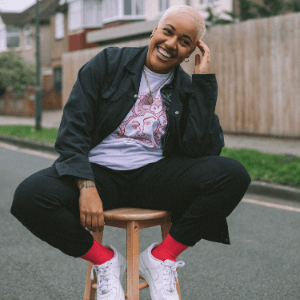
Tanya Compas (she/her) is an experienced youth worker and activist, supporting queer Black young people in London. She is constantly working on projects to support the Black community including the Queer Black Christmas which she set up last year to support other Black queer youth who, like herself at the time, were homeless or estranged from their families. This event provided them with an alternative way to celebrate with their community and chosen family.
Recognising the specific support that queer Black young people need, Tanya’s next big project has been setting up a new organisation ‘Exist Loudly’ which is set up to create spaces of joy and community for queer Black young people. The organisation will run digital workshops, mentoring sessions and social events. Most notably, they have launched a research project to understand the experiences of Black LGBT+ youth in the UK in the areas of health care, education and home; the first of its kind in the UK.
Exist Loudly raised over £100,000 to begin this extremely important work, which they were able to split with other great Black queer projects. To keep informed about what happens next follow the Exist Loudly project on social.
4. Purple Rain Collective
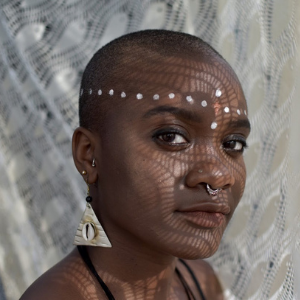
Photo credit: Myah Jeffers
Tobi Adebajo (they/them) is a community focused queer hair stylist, organiser, parent, scientist, singer, and writer who works with prowess. They centre their work on the depths and nuances of various topics such as queer love, politics, black sexuality, healing, and more.
Their work aims to highlight the varying inaccessibilities of social spaces, especially queer ones.
Tobi recently released a queer punk album ’Wastewomxn’ with their transcontinental band A.T.K. The music is fuelled by the group’s Yoruba and Japanese cultures and diasporic existences.
Tobi is a core member of the Purple Rain Collective and has also created an ever-growing network for Black Femmes & Femmes of Colour. This year Purple Rain Collective in particular have gone above and beyond to support the LGBT+ community. Throughout the pandemic, they have been signposting QTIBPOC to resources and support, and tirelessly donating to emergency fundraisers on a global scale. The collective has organised events such as online meditation sessions, and are currently building care packages that will be distributed to low income QTIBPOC families in the UK.
5. Li Benedetti
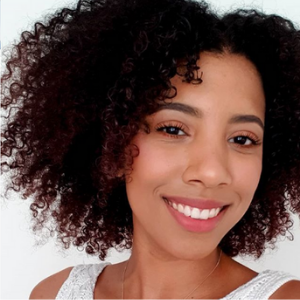
Li Benedetti (they/them) is a Black Brazilian non-binary creative producer and LGBT+ activist based in London who advocates and supports the QTIPOC community through their work. Li has worked on many projects for a number of organisations like Google, Albert Kennedy Trust and Stonewall where they hosted Stonewall’s Children and Young People Conference in 2019. Passionate about sharing the complexities of what it means to be LGBT, Black, and someone with a learning disability, they use their experiences to create digital content and run community-based events and programmes.
During the pandemic, Li compiled a number of ways to support the QTIPOC community as well as educate allies to step up meaningfully. Through infographics like ‘things not to say to a Black person’, 'how to be a better trans ally’ and ‘coming out tips from a trans person’ they have created invaluable resources. They are now working on setting up an online store inspired by some of these infographics. They have also set up LGBTQIA+ livestreams with topics ranging from community and the importance of QTIPOC only spaces as well as looking at queer fashion and beauty.
Apart from their online activism they are planning this year’s Trans Winter Wonderland, which is a trans-only festive event they fundraised for and ran for the first time last year.