
Families
Only one in five bi people (20 per cent) are out to all their family compared to three in five gay men and lesbians (63 per cent)
Two in five bi people (42 per cent) hide or disguise their sexual orientation at work for fear of discrimination
Research gives insight into the unique experience of bi people
Stonewall, the UK’s leading charity for lesbian, gay, bi and trans equality, has released new research that shows bi people are significantly less likely to be out than gay men and lesbians, whether that’s at home, in education, at work, or as part of a faith community. The study also reveals the impact bi-erasure and biphobia has on health and well-being of bi communities.
Bi people are three times less likely than gay men and lesbians to be out to all of their family.
The report, based on YouGov polling of over 5,000 people, of whom 1,769 identified as bi, reveals that bi people are three times less likely than gay men and lesbians to be out to all of their family (20 per cent compared to 63 per cent). While one third of bi people (33 per cent) aren’t open about their sexual orientation with any of their family.
The research also found that while two in five gay and lesbian people (44 per cent) are out to everyone at their educational institution, only one in five bi people say the same (23 per cent). Meanwhile, two in five bi people (42 per cent) have hidden or disguised that they were bi at work for fear of discrimination.
Bi people are often a forgotten part of the LGBT acronym.
Bi people are often a forgotten part of the LGBT acronym and can face ‘’double discrimination’: not only do they face abuse from straight people, but also from lesbian and gay people.
As one respondent to Stonewall’s Bi Report said: ‘Being bisexual means finding yourself excluded by gay people and straight people in social settings. I only tell my friends about my sexuality, meaning it is hidden from my family and my work colleagues. Bisexuality is a hidden sexuality through people’s lack of acceptance.’ Kendra, 32 (Scotland)
Stonewall research further shows how experiences of biphobic discrimination and rejection from family and friends significantly increase the risk of poor mental health for bi people. Nearly three in five bi people (59 per cent) reported experienced depression, compared to just under half of gay and lesbian people (46 per cent). Meanwhile, over one in four bi people (26 per cent) reported self-harming compared to one in ten gay and lesbian people (11 per cent).
Nancy Kelley, Stonewall’s Chief Executive, said: ‘For the first time we have research specifically looking at what life is like for bi people in Britain. What we’ve found is that across the board biphobic stereotypes and prejudices are making life harder for bi people and, too often, their experiences of discrimination are either undermined or ignored altogether.
‘This stops bi people in our communities from feeling able to share really important parts of their lives with those around them, hurts their mental health and gets in the way of them accessing appropriate help and support when they need it.
‘We all need to learn more about the issues bi people face, and work harder to make sure they are welcome and supported in our schools, workplaces, and communities. It is down to all of us to tackle ignorance about bi identities, and to challenge the damaging bi-erasure and biphobia that bi people of all ages experience.
‘We want every LGBT person to thrive and be confident about who they are. Accepting bi people without exception is essential to creating a world where everyone, everywhere is free to be themselves.’
Today we set out a new chapter for Stonewall as we launch our 2021-5 Strategy: Free to Be.
It’s almost a year since I took up the role of Chief Executive here at Stonewall. I’ve had so many rich and powerful conversations with people from across the LGBTQ+ movement, both here in the UK and among our many global partners, about what matters to our communities, what change is desperately needed and how Stonewall can be a great activist and partner in the movement.
I’ve reflected a lot on what we need to do and be at Stonewall to fight for – and build support for – our communities.
At the heart of it, we at Stonewall believe that LGBTQ+ people have limitless potential, and we imagine a world where all LGBTQ+ people of all identities experience not only equal opportunities, but equitable outcomes. Where our governments, communities, faith institutions and families don’t merely allow us to exist, but actively shield us from harm and help us thrive.
To create the world we imagine, our new strategy focuses on three pillars: Freedom, Equity and Potential. And the only way that we can make real progress is by working in partnership across the movement, in the UK and globally.
Over the coming four years you can expect to see us can expect to see us working on:
Freedom
- A legally enforceable ban on conversion therapy
- Laws that help prevent hate crimes and support LGBTQ+ asylum claims
- Legal recognition for LGBTQ+ people and our relationships
Equity
- Accessible and high-quality healthcare for all LGBTQ+ people
- Strengthening relationships with faith communities and communities of colour
- Supporting and represent LGBTQ+ people across our lives
Potential
- Expanding our workplace and empowerment programmes
- Championing LGBTQ+ inclusion in sport and schools
- Supporting Pride in all its forms
You might also notice that we look and sound a bit different. The wonderful and very clever Revolt (a purpose consultancy) and activist agency and Jones Knowles Ritchie (a design-led creative company) have helped us build a strong and clear message about who we are and what we stand for, alongside a fresh and confident new look. We have moved away from ‘Acceptance without Exception’ which no longer feels like the right focus for us. Today we stand for the freedom, equity and potential of all LGBTQ+ people.
We are so grateful to Revolt and Jones Knowles Ritchie for their generous support. And we are so grateful to the photographer Ally Schmaling, who has allowed us to use their beautiful portraits of LGBTQ+ people. We hope you love their work as much as we do.
So, now you know about the world that we imagine at Stonewall, I want to ask: do we imagine the same world?
If you can imagine a world where there is freedom, equity and limitless potential for every LGBTQ+ person, we want you to stand with us.
Whether you’ve supported us since 1989; you’re just coming out; you want to be a champion for your LGBTQ+ friends, relatives or colleagues; you’re concerned by the rise of anti-LGBTQ+ hate groups; you’ve felt overlooked by us in the past; you want to step up as a role model or leader – we can’t create the world we imagine, the world our communities deserve, without you. Join us.
An intergenerational Q&A about LGBTQ+ education in schools.
Claire Dowie and Rachel Watkeys-Dowie are a mother and daughter who both identify as queer. Claire is 64, grew up in Birmingham and made a career in playwriting, stand-up comedy and performance. Rachel is 28, grew up in London and works as a TV producer and stand-up comedian.
As part of our inclusive education campaign, we wanted to understand what school was like for LGBTQ+ people from different generations. We set up a Q&A between Rachel and Claire to find out how much – or how little – had changed when it came to learning about LGBTQ+ identities and issues in school, 35 years apart.
Their answers show how transformative a truly inclusive education could be, and how little support and guidance many LGBTQ+ young people have while in school. Help us give more LGBTQ+ children and young people the start in life they deserve by donating today.
Claire, do you remember being taught anything about queer people, or issues, at school?
No, not a thing. Next question!
There was nothing – even more so because I went to an all-girls’ school. There was no talk of anything untoward.
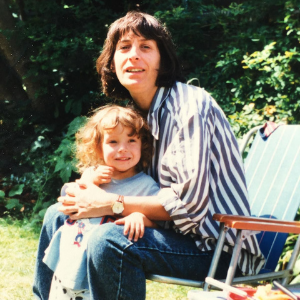
Claire and Rachel in the garden.
Did you learn anything from peers while you were young, or was it not until you were an adult that you started to realise what it could mean to be LGBTQ+?
I think I saw The Killing of Sister George on telly. And I thought, ‘Oh, that's what it's all about’. Before that, I never heard anything. Apart from people sort of muttering – about blokes, mostly – being a little bit effeminate or ‘good to his mother’. There was nothing blatantly obvious.
It was kind of accepted for women to live together then. It was spoken about as they were spinsters who couldn't get a man – but there was never any idea about being lesbian or gay, and certainly not queer.
There was no education in schools or in culture. Even though you had people like Kenneth Williams on the radio speaking Polari, you didn't think of it as being gay. There was never any discussion of people being in couples. So Kenneth Williams was an effeminate man, but you'd never imagine that meant he could be in a relationship with another man.
There was no education in schools or in culture.
And moving on to when Section 28 was being brought in. Do you remember what the climate felt like then? Did it feel like a rollback?
No. Back then, you had women's liberation, gay liberation, Black liberation, all coming around the time, around the late 70s, early 80s. It was fabulous being a female stand-up then because all the blokes had to listen to you for the first time ever, because it was trendy.
It felt like Section 28 came about because people were going along with all the newfound freedom, people were going along with women's liberation, Black liberation. And then the establishment went: No, we’re not having that. And they clamped down on it all.
And when you were having kids five years later, were you thinking about what it would be like for them at school, or did feel it would still be much better than it was for you?
Honestly, I was more concerned with myself! I was freaking out because I was quite a butch dyke before then. I got through school being a comedian and a little bit of a bully.
At my school dance, everybody danced with me. As one girl said: you're the only boy in the building, so everybody wants to dance with you. I felt like I was in heaven.
So I thought: if I got through school OK, so would they.
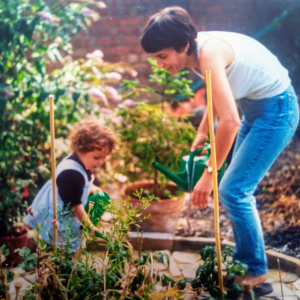
Claire and Rachel watering their plants.
Did you think about what you would say to Rachel and Mike about being from a queer family, or was it something that didn’t need to be discussed explicitly?
Claire: It was never an issue. To be honest, I don’t see it that way and it never occurs to me. I always thought: why should I announce my sexuality, when it kind of fluctuates anyway?
Rachel: I remember one of my school friends said, ‘Oh your mum's a lesbian,’ and I was like, ‘What?!’. I knew that my family were queer but ‘lesbian’ felt like a dirty word in school. That was interesting because it hadn't been made into a big deal at home, and so I hadn’t equated those two words before.
Whenever we did lessons that could’ve included those topics, I sat there terrified that they would talk about being gay.
Rachel, by the time you were in secondary school Section 28 was gone, and it was fine to talk about LGBTQ+ people and issues in the classroom. Did you witness that?
Not even a little bit. Literally not at all. Not in Sex Ed, there weren’t any special classes or anything like that. Teachers were completely unequipped.
Whenever we did lessons that could’ve included those topics, I sat there terrified that they would talk about being gay. I was scared that if people got given definitions or terminology, then I’d be labelled as the lesbian and excluded or bullied in a way that I never had been before. I felt like I was allowed to exist in the way that I was because there was no definition for me. I was just allowed to be Rachel. So I was genuinely nervous in those Sex Education classes. I was like, I can't let that happen. I probably would’ve left class if they'd done that.
What about outside of lessons themselves?
We had one student who went around trying to educate people. ‘Gay’ was used as a derogatory term all the time – ‘That's rubbish, that's so gay’. When this guy heard people doing that he’d come back with: ‘Why are you saying that? What do you think gay is?’ and even call out the teachers for not doing anything about it.
That was amazing, but the flipside was that he was bullied so badly that at break or lunch he was kept in a classroom so that the other students couldn't get him. Instead of dealing with the homophobic bullying they just kept him away from everyone else.
The reality was that my teachers weren’t going to deliver that education in a confident way that celebrated LGBTQ+ people.
So bearing in mind your school environment, it might have been worse if you had inclusive Sex Ed?
Claire: It depends how they teach the lesson. If they're going to introduce you as an adjunct to what is normal, then obviously people are going to attack it. Teenagers are trying so hard to be normal.
Rachel: I think if I'd had any kind of education on sexuality or gender at school, it would've just been someone saying, ‘This is the label that’s used if you're a girl who dates other girls’.
The reality was that my teachers weren’t going to deliver that education in a confident way that celebrated LGBTQ+ people. Whereas being shown examples of brilliant people doing something different, being shown people who are just living their lives and loving it... that is what actually makes you feel seen. And you can relate to it in your own private way without feeling singled out.
And since you weren't taught this stuff at school, who filled in those gaps?
Rachel: It was Mum. Yeah, so it's completely unfair of me to say any of this. I was raised by Mum and Dad who are both super queer. The door was always open – I knew they’d always engage with me and tell me the truth.
Sexuality never really came into it, particularly by the time I was dating. But there were times when I came home and said, ‘Everyone's asking if I'm a boy or a girl and I don't know what to do’. The answer was never, ‘You should wear a dress or grow your hair longer or stop acting like a boy’.
Having Mum as a parent meant I had a level of confidence in being masculine presenting, in having a queer identity, that a lot of people didn't.
Can you try and summarise what you think the main similarities and differences were in your experiences at school?
Claire: I was the boy in a female school. And you were probably the boy in the mixed school.
Rachel: I was just allowed to be something different. Just outside it. Also bisexuality really came into fashion, which helped me out. When Jessie J came out as bi and then Katy Perry was singing ‘I kissed a girl and I liked it’, all the girls felt like, ‘Oh, I've got to kiss a girl’. And actually a lot of them maybe didn't actually fancy girls, so then it was almost… ‘Well, Rachel is excellent at almost being a boy’.
We’ve lived quite parallel lives, I guess.
Claire: But I did mine in secret.
Rachel: And I was allowed to do mine openly. And also having the extra bolstering of not having to feel wrong the whole time, or not having the same level of doubt. There was at least that sense of: Mum's done this, and she turned out OK.
The younger you can start people off, understanding that there's so many millions of types of people, the better.
In an ideal world, we’d like to see really inclusive school environments from an early age. So using a range of picture books showing different types of families, talking about LGBTQ+ role models in lessons in an incidental way. Basically embedding it across the curriculum rather than: in one lesson, we're going to mention this one thing. How do you think that sounds?
Claire: The younger you can start people off, understanding that there's so many millions of types of people, the better. Doing it as a teenager is almost the worst possible time – there's a pecking order and they're all aware that they don't want to be the misfit. The conditioning of people to be ‘normal’ starts incredibly early and so pushing back on that early on is crucial.
[My partner] will tell you, he lost his dad when he was four – and when he went to primary school, the teacher told the class, ‘Write a story about your daddy’. And he didn't have one. It’s the same principle.
Rachel: It others you. And when you’re only showing picture books with mummy and daddy, when you’re dressing kids just in pink or in blue, you’re already maintaining a straight status quo. It’s so all-consuming from an early age.
I totally agree that the subtle, inclusive approach from a young age, but not making a big thing about it, is absolutely the way to go. I think that would’ve been amazing. I kind of had that from having you guys as parents but if I'd had that at school as well… I would have been possibly too confident!
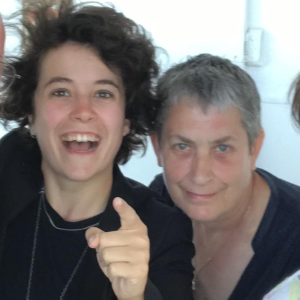
Rachel and Claire at a recent family party.
All LGBTQ+ children and young people deserve an education that reflects who they are. Join us in building a world where LGBTQ+ youth are safe, seen and heard. Stop the threats to LGBTQ+ inclusive education and donate today.
Find out about our campaign for LGBTQ-inclusive education.
‘Whenever I remembered the treatment I’d had, I would start physically shaking,’ – survivors of conversion practices share their experiences.
Shockingly, conversion practices remain legal in the UK. And while this remains the case, LGBTQ+ people are at risk of harm. According to the Government's LGBT Survey, 7% of LGBT+ people have been offered conversion therapy, rising to 13% of trans people and 10% of asexual people.
Behind those cold numbers are real people – many of whom still carry with them the long-lasting emotional scars of being made to feel broken. Of being told that who they are is wrong, and that they need to be ‘fixed’ or ‘cured’.
Below, seven survivors share their harrowing experiences of this degrading practice – and the lasting damage it has had on them.
1. “The guilt around my sexuality is hard to shake.”
‘I went into total denial about my sexuality and embraced the idea that I had been “cured”. At the same time, my mental health bombed and my self-harm increased dramatically. In 2009, I tried to kill myself.
“It was only last year, aged 38, I finally accepted that I am gay. Even today, when I know that God loves me for who I am, the guilt around my sexuality is so hard to shake.’
George – a gay woman in her 30s
2. “It is still difficult to see how I am worthy of love.”
‘My pastor, along with his wife and a counsellor, did all they could to convince me that it was wrong to be trans. Even though I’m unsure what I believe anymore, I still live with the fear that I will go to hell.
One of the most destructive impacts was that I began to believe I was unlovable. After all, if I was being told that even God couldn't bear who I am, then it was, and sometimes still is, difficult to see how I am worthy of love.’
Liam – a trans man in his 30s
3. “I started to wonder if the therapist was right.”
‘It took years for me to seek mental health support again, in case the same thing happened. I started to feel hatred towards myself and a fear of engaging with people who might have supported me – whether that was the LGBT community or the South Asian community.
And I became insecure in my relationship. I started to wonder if the therapist was right: had I been used by my partner? Or groomed? That took a long time to overcome.’
Amir – a gay man in his 20s
4. “I have a difficult time with relationships, and intimacy scares me.”
‘Today I struggle with trauma, PTSD, and an eating disorder which are all linked to my conversion therapy experiences.
I have a difficult time with relationships, and intimacy scares me. A lot of people can’t comprehend what it’s like to have experiences like mine, even LGBT people. My parents still don’t understand why I didn’t want to have conversion therapy, or why it was so damaging. They think all therapy is a good thing.’
Eli – a gay man in his 20s
5. “I’d still have flashbacks from my sessions 40 years later.”
‘Whenever I remembered the treatment I’d had, I would start physically shaking. In that sense you could say that the therapy “worked”, in that it affected my body. But, in terms of my mind, and my thoughts, it only made me hate myself more.
The treatment didn’t stop, or even decrease, my feelings of dysphoria. I struggled with it for decades. It was only when I retired early – aged 55 – that I felt I could live openly as myself. And while things got so much better, I’d still have flashbacks from my aversion therapy sessions 40 years later.’
Carolyn – a trans woman in her 70s
6. “My therapy sessions put the shame and self-hatred I felt into overdrive.”
‘Conversion therapy stole precious time I could have spent exploring my sexuality, learning about myself, and building my relationship with my parents. At a certain point I thought I had become asexual, and this felt like an accomplishment.
It also took away my self-confidence. Because if I had truly believed that conversion therapy was right, what else was I wrong about? My therapy sessions put the shame and self-hatred I felt as a teenager into overdrive. I felt responsible for changing myself, and if I didn’t manage this, then I would have failed yet again.’
Joe – a gay man in in his 30s
7. “Dating has been impossible at times ... sometimes I have felt physically sick.”
‘My pastor taught me to be afraid of the secular world and even of Christians with more liberal views. I’ve also found it difficult to become part of the LGBT community, since I was taught to fear LGBT people.
Dating has been impossible at times – sometimes I have felt physically sick when starting a relationship because the feelings of “I shouldn't be here” come back so strongly.’
Emily – a gay woman in her 30s
Some names have been changed.
All of these stories can be read in full on the Ban Conversion Therapy website.
If you’ve been impacted by any of the issues discussed this article, visit the Ban Conversion Therapy website for a list of support services.
All LGBTQ+ people deserve to be protected from abuse. Find out how you can support a ban on conversion practices that leaves no one behind.
This year we’re celebrating 50 years of Pride in the UK. In this article, we’ll chart the major moments in LGBTQ+ history since the first Pride in 1972, and ask what still needs to change for LGBTQ+ people, today and in future.
2022 is a pivotal year for LGBTQ+ history in the UK. Fifty years after the first Pride in London, it’s time to reflect on everything our movement has achieved. At that first Pride in 1972, around 2,000 participants marched together, calling for gay rights. And throughout the 1970s, there were many other milestones – Gay News, Britain’s first newspaper, was founded. Switchboard, a London-based info and support helpline that still runs today, was established. The first trans conference was held in Leeds and the first gay and lesbian Trades Union Congress conference took place to discuss workplace rights. In a watershed moment, Maureen Colquhoun became Britain’s first openly lesbian MP.
In the 1980s, progress sped up rapidly as more LGBTQ+ people came out and demanded equal treatment. We saw the first Black Gay and Lesbian Group being formed, as well as the first bi group in the UK. Chris Smith became the first openly gay MP, and the Lesbian and Gays Support the Miners campaign was launched. But as well as increased visibility, the LGBTQ+ population in the UK faced a backlash. In 1988, Margaret Thatcher introduced Section 28, a piece of legislation which banned local authorities from ‘promoting homosexuality’ and effectively banned the discussion of LGBTQ+ issues in schools. More happily, in 1989, Stonewall was founded to fight back against Section 28.
The 1990s saw the World Health Organisation declassify same-sex attraction as a mental illness, and the age of consent for sexual relations between men lowered from 21 to 18. Trans youth charity Mermaids was founded, and two openly gay MPs are elected in the 1997 elections.
Under Tony Blair’s government in the 2000s, a raft of positive legislation was introduced. The UK Government lifted the ban on LGB people in the armed forces, the age of consent was lowered to 16, same-sex couples were granted equal rights when applying for adoption, and Section 28 was finally repealed across the UK. We also saw the Civil Partnership Act and the Gender Recognition Act introduced in 2004, granting same-sex couples the same rights as married couples, and allowing trans people to acquire new birth certificates. Finally, The Equality Act (Sexual Orientation) Regulations 2007 outlawed the discrimination in the provision of goods, facilities, services, education and public functions on the grounds of sexual orientation.
In the 2010s, the Equality Act added gender reassignment as a protected characteristic. We saw the introduction of same-sex marriage across the UK, and Ruth Davidson became the first openly gay leader of a political party in the UK. The ban on donating blood for gay and bi men was lifted, and the UK Government issued a posthumous pardon to all men convicted under sexual offences laws which criminalised people for being bi or gay. And we saw the first Trans Pride and Bi Pride events take place in the UK.
So it's fair to say we’ve come an incredibly long way since 1972. By 2019, London Pride saw 1.5 million people celebrate and protest in support of LGBTQ+ rights. But looking around us today, it’s clear that we still haven’t reached equality. Just this year, we saw online estate agency Purple Bricks remove a listing last month when the owners of a house in Surrey refused to allow two gay men to view their property. Luke Whitehouse was told by the owners that they could not sell the house to ‘two men in partnership […] as it is contrary to the gracious teaching in God’s Word’. While we know progress has been made, we still have to battle regressive attitudes across society.
More frighteningly, reports of anti-LGBTQ+ hate crime and violence continue to rise. Barely a month into this year, we saw coverage of the murder of Dr Gary Jenkins, who was killed in a park by attackers hurling homophobic abuse. The prosecution lawyer, employed to win justice for Gary, said in his opening statement that Gary’s ‘sexual predilections were to be his undoing… he rendered himself hopelessly vulnerable and an easy target’. The lawyer later apologised and Gary’s murderers will soon be jailed, but nevertheless, stereotypes about gay and bi men being promiscuous are still being used justify violence and blame the victims of horrific attacks. In 2022, we are still not safe in our own communities.
So, this year, we’re looking ahead to imagine what we want the world we want for LGBTQ+ people today, and in fifty years’ time. Right now, we’re campaigning for a full, legislative ban on conversion therapy in the UK, so that no more LGBTQ+ people are subject to this degrading practice. We’re also fighting for better treatment for LGBTQ+ refugees, who deserve not only safe passage but a warm welcome when they arrive in our country, and for equal access to IVF, so that LGBTQ+ people don’t need to break the bank to become parents.
What do you want to make a reality by Pride 100 in 2072? Let us know on Twitter by tagging @stonewalluk and using the hashtag #TakePride.
Photo: Whitney and Megan Bacon-Evans
The practical and financial costs that face many LGBTQ+ people who want to have children are unfair and must be challenged.
In this article, we explore how improving access to IVF will remove barriers for those looking to conceive, particularly lesbians, bi women and some trans people.
Where we stand
Stonewall and DIVA’s 2021 LGBTQI+ Insight Survey 2021 found that 36% of respondents who had children experienced barriers or challenges when starting their family. One in five of those stated that the greatest barrier or challenge was the high cost of private fertility treatment.
Currently, the National Institute for Health and Care Excellence (NICE) guidelines state that funded access to IVF in England is only available to women ‘who have not conceived after two years of regular unprotected intercourse or 12 cycles of artificial insemination (where six or more are by intrauterine insemination)’.
The UK Government’s 2022 Women’s Health Strategy pledged to remove additional financial barriers to In-Vitro Fertilisation (IVF) for female same-sex couples in England. This included the requirement to pay for artificial insemination (Intrauterine insemination or IUI) to prove fertility status before accessing IVF services. But we’re still waiting - only four of the 42 integrated care bodies have made this change as of April 2024 and no changes have been made in the past year.
Local ICBs choose how to delegate NHS funding – and many regional health boards in England still require female same-sex couples to self-fund at least six cycles of IUI before they are eligible for NHS IVF treatment. Others even require up to 12 cycles of self-funded artificial insemination – this is far beyond what is recommended in guidelines provided by the National Institute for Health and Care Excellence (NICE)
While lots of couples will conceive using IUI, the costs quickly rack up for those who don’t. Let’s start to add up the costs:
- IUI costs between £350-£1,600 per cycle at a private clinic, and same-sex female couples usually have to pay for 6-12 IUI cycles privately before they can access NHS services.
- 90% of Integrated Care Boards (ICBs) in England are still falling short of the Women’s Health Strategy’s commitment to 'relieve additional burdens [for same-sex female couples]' looking to form a family of their own.
- 19% of ICBs in England still require up to 12 self-funded cycles of artificial insemination (IUI) before offering any further support – meaning that female same-sex couples have to pay up to £25,000 before accessing NHS-funded IUI or IVF support.
- Accessing IVF is a ‘postcode lottery’ – meaning couples living in different areas could face additional hurdles when trying to conceive.
This policy creates significant practical and financial barriers for prospective parents, particularly lesbians, bi women and some trans people. Including additional costs, a couple who needed to fund twelve IUI cycles could have to spend up to £25,000 before being eligible for NHS care. For many, this cost is impossible to afford.
What needs to change?
Ensuring equitable access to NHS funding for IVF will mean that starting a family won’t be so inaccessible for our communities.
We know that better access to fertility services can be achieved – in Scotland, up to six cycles of IUI are funded for all couples, provided they meet the nationally agreed NHS criteria. In 2018, 70% of IUI cycles and 40% of IVF cycles for female same-sex couples were funded in Scotland. In Wales, 14% of IUI cycles and 31% of IVF cycles were funded in the same year. Clearly, there’s a lot of progress to be made across all areas of the UK.
Whitney and Megan Bacon-Evans are a lesbian couple highlighting the human impact of the current restrictions: “We were shocked and devastated to discover the discrimination that lesbian couples and bisexual women face in starting their family. Our local NHS policy states that female same-sex couples must self-fund 12 rounds of artificial insemination, 6 of which must be IUI in a private clinic. As we have chosen a sperm donor from a sperm bank, our only option is to have artificial insemination in a private fertility clinic.
“Female same-sex couples are being forced to pay tens of thousands of pounds in artificial inseminations in expensive private clinics to prove that they are infertile before they are eligible for any fertility treatment on the NHS. However, cis heterosexual couples can qualify for IVF on the NHS if they have not become pregnant after two years of unprotected sex. While this is a long time, it is at no additional financial cost."
LGBTQ+ people deserve the same help to become parents as everybody else. We must ensure that lesbians, bi women, and other LGBTQ+ people who want to conceive should have equitable access to NHS-funded care.
Make access to IVF equal - email your MP today.
Donate to support our campaign for fertility equality.
References
Everyone deserves the chance to start a family, no matter their sexuality or gender identity.
Unfortunately, as things stand, there are significant practical and financial costs facing many LGBTQ+ people who want to have children. A survey of LBTQ+ women and non-binary people conducted by Stonewall and DIVA magazine found that 36% of respondents who had children had experienced barriers or challenges when starting their family. One of these barriers lies in unequal access to IVF treatment, including the fact that policies vary dramatically across the UK.
Accessing IVF is still a postcode lottery.
The UK Government’s 2022 Women’s Health Strategy pledged to remove additional financial barriers to In-Vitro Fertilisation (IVF) for female same-sex couples in England. This included the requirement to pay for artificial insemination (Intrauterine insemination or IUI) to prove fertility status before accessing IVF services. In October 2023, Health Under-Secretary Maria Caulfield, said that the implementation of this commitment was a priority area and that it “will not take 10 years for the changes to be implemented.”
However, many regional Integrated Care Boards (ICBs) in England still require female same-sex couples to self-fund at least six cycles of IUI before they are eligible for NHS IVF treatment. Others even require up to 12 cycles of self-funded artificial insemination – this is far beyond what is recommended in guidelines provided by the National Institute for Health and Care Excellence (NICE). In fact, only four of the 42 integrated care bodies have made this change as of April 2024 and no changes have been made in the past year.
With intra-uterine insemination (IUI) costing between £350-£1,600 per cycle at a private clinic, a couple who needed to fund twelve IUI cycles and associated medical fees could have to spend up to £25,000 before being eligible for NHS care. For many in England, this cost is impossible to afford. You can find out more about IVF policies in Scotland, Wales, and Northern Ireland in this article.
This lack of equitable access to NHS funding for IVF means that conceiving children isn’t an option for lots of people in our communities. With many cis, straight couples qualifying for IVF on the NHS if they have not become pregnant after two years of unprotected sex – at no additional financial cost – this is just another way in which LGBTQ+ individuals are discriminated against in society. Policies around IVF particularly impact bi women, lesbians, and some trans people. You can read more about the unequal burden of proof on LGBTQ+ couples in this article.
Supporting queer families benefits us all.
Aside from the simple fact that we all deserve equal rights, supporting queer families benefits us all. In a world that almost exclusively centres and advocates for the nuclear, cis, straight family unit, the creation of queer families is a radical act. There is beauty in allowing queerness to challenge the landscape of parenting – to expand the limited mainstream view of what a family can, and should, look like. To help us understand that it doesn’t matter who is part of a family – what makes a family is the love, care, and nurture that flows from all loving and caring parents, whether they’re queer or not.
That’s why we’re asking you to exercise your rights as a constituent and write to your MP demanding equal access to IVF for LGBTQ+ people. You can use our tool to see the state of play in your local area, and request that your representative calls on the UK Government’s Secretary of State for Health and Social Care to commit to a review of the inequality in access to NHS-funded fertility services in England. We must speak up together to bring an end to the ICB postcode lottery and ensure that lesbians, bi women, and other LGBTQ+ people who want to conceive have equal access to NHS-funded care.