
Blog
Nobody would leave their home country unless they have no other option.
LGBTQ+ refugees are some of the world’s most vulnerable people – at risk of persecution and often, certain death. Here’s what we can do to help.
The journeys that LGBTQ+ refugees embark upon to reach safer shores are gruelling and fraught with risk. And the reality is that when – or if – they reach sanctuary, the challenges are far from over. Those who survive the journey to countries like the UK are often met with suspicion and cruelty, where they should be welcomed and supported.
Those who survive the journey to countries like the UK are often met with suspicion and cruelty.
The trauma refugees experience before, during and after fleeing their home countries is hard to comprehend for those of us who have always lived in relative safety. And sadly, arriving in the UK is only the beginning of a new struggle for many refugees. Having to rebuild a life from scratch, with limited access to vital resources including benefits, housing and education, leaves them under immense stress which negatively impacts their mental health and ability to integrate.
If asylum claims are rejected, LGBTQ+ refugees risk being deported to countries where they could be imprisoned, tortured or even killed for being themselves.
This would be tough for anyone. For LGBTQ+ refugees, these problems are compounded by the requirement to ‘prove’ that they are who they say they are. Applicants often struggle to have their sexual orientation or gender identity believed. In many cases, the only ‘evidence’ someone has to prove their identity is their own testimony. They have to talk about the most personal and intimate aspects of their lives to a stranger, who then decides whether or not they are telling the truth. In many cases this may be the first time they have told someone who they are, because in some countries, disclosing you are LGBTQ+ will mean certain death. If asylum claims are rejected, LGBTQ+ refugees risk being deported to countries where they could be imprisoned, tortured or even killed for being themselves.
In some countries, disclosing you are LGBTQ+ will mean certain death.
At Stonewall, we’re advocating for LGBTQ+ refugees in as many ways as we can. Demanding action from governments can and does make a difference, and alongside our partners, including Rainbow Migration and Rainbow Railroad, we call on governments to respond to emerging global issues.
As an example, in August 2021, we lobbied the UK Government to ramp up humanitarian evacuations of LGBTQ+ Afghans who are at risk under the Taliban.
We also spent several years lobbying for the protection of those fleeing persecution in Chechnya. Working in partnership to apply pressure increases the likelihood of the UK Government taking note and prioritising our communities at critical times.
More widely, we’re campaigning for better UNHCR guidelines on deciding LGBTQ+ asylum claims, and for fairer outcomes for LGBTQ+ refugees here in the UK.
As part of this, we worked with partners like Rainbow Migration to fight against the Nationality and Borders Bill, which sadly was passed by Parliament in April 2022. This new law will make it even more difficult to ‘prove’ that you are LGBTQ+. It also punishes people who stop somewhere on their way to the UK or those who don’t claim asylum immediately after arriving here by granting them a shorter form of leave.
The impact this will have on LGBTQ+ people is huge, as many are unaware that they can claim refugee protection on the basis of their sexual orientation or gender identity, may be afraid of claiming asylum as they do not wish to talk about it, or may not realise they are LGBTQ+ until they have lived here for some time.
On top of that, under the deal with Rwanda, some of these people will be detained and sent 4,000 miles away, to a country that is not safe for LGBTQ+ people.
Our partners at Rainbow Migration are calling for the next Prime Minister to scrap the Rwanda deal and to protect LGBTQ+ people seeking safety here. We have also joined Rainbow Migration’s ‘No Pride in Detention’ campaign to end the immigration detention of LGBTQI+ people. You can add your name here.
All LGBTQ+ refugees deserve the chance to rebuild their lives free from homophobia, biphobia and transphobia.
All LGBTQ+ refugees deserve the chance to rebuild their lives free from homophobia, biphobia and transphobia. We’re determined to do all we can to protect the right to refuge for our LGBTQ+ siblings arriving in the UK, and to ensure they are treated with dignity and compassion they deserve.
An intergenerational Q&A about LGBTQ+ education in schools.
Claire Dowie and Rachel Watkeys-Dowie are a mother and daughter who both identify as queer. Claire is 64, grew up in Birmingham and made a career in playwriting, stand-up comedy and performance. Rachel is 28, grew up in London and works as a TV producer and stand-up comedian.
As part of our inclusive education campaign, we wanted to understand what school was like for LGBTQ+ people from different generations. We set up a Q&A between Rachel and Claire to find out how much – or how little – had changed when it came to learning about LGBTQ+ identities and issues in school, 35 years apart.
Their answers show how transformative a truly inclusive education could be, and how little support and guidance many LGBTQ+ young people have while in school. Help us give more LGBTQ+ children and young people the start in life they deserve by donating today.
Claire, do you remember being taught anything about queer people, or issues, at school?
No, not a thing. Next question!
There was nothing – even more so because I went to an all-girls’ school. There was no talk of anything untoward.
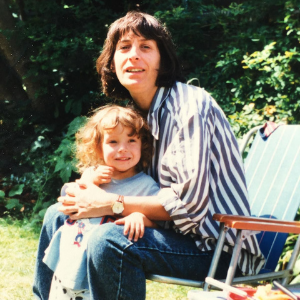
Claire and Rachel in the garden.
Did you learn anything from peers while you were young, or was it not until you were an adult that you started to realise what it could mean to be LGBTQ+?
I think I saw The Killing of Sister George on telly. And I thought, ‘Oh, that's what it's all about’. Before that, I never heard anything. Apart from people sort of muttering – about blokes, mostly – being a little bit effeminate or ‘good to his mother’. There was nothing blatantly obvious.
It was kind of accepted for women to live together then. It was spoken about as they were spinsters who couldn't get a man – but there was never any idea about being lesbian or gay, and certainly not queer.
There was no education in schools or in culture. Even though you had people like Kenneth Williams on the radio speaking Polari, you didn't think of it as being gay. There was never any discussion of people being in couples. So Kenneth Williams was an effeminate man, but you'd never imagine that meant he could be in a relationship with another man.
There was no education in schools or in culture.
And moving on to when Section 28 was being brought in. Do you remember what the climate felt like then? Did it feel like a rollback?
No. Back then, you had women's liberation, gay liberation, Black liberation, all coming around the time, around the late 70s, early 80s. It was fabulous being a female stand-up then because all the blokes had to listen to you for the first time ever, because it was trendy.
It felt like Section 28 came about because people were going along with all the newfound freedom, people were going along with women's liberation, Black liberation. And then the establishment went: No, we’re not having that. And they clamped down on it all.
And when you were having kids five years later, were you thinking about what it would be like for them at school, or did feel it would still be much better than it was for you?
Honestly, I was more concerned with myself! I was freaking out because I was quite a butch dyke before then. I got through school being a comedian and a little bit of a bully.
At my school dance, everybody danced with me. As one girl said: you're the only boy in the building, so everybody wants to dance with you. I felt like I was in heaven.
So I thought: if I got through school OK, so would they.
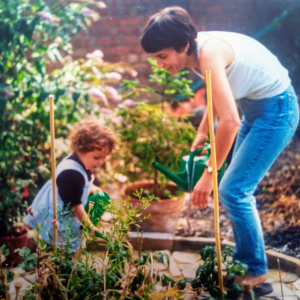
Claire and Rachel watering their plants.
Did you think about what you would say to Rachel and Mike about being from a queer family, or was it something that didn’t need to be discussed explicitly?
Claire: It was never an issue. To be honest, I don’t see it that way and it never occurs to me. I always thought: why should I announce my sexuality, when it kind of fluctuates anyway?
Rachel: I remember one of my school friends said, ‘Oh your mum's a lesbian,’ and I was like, ‘What?!’. I knew that my family were queer but ‘lesbian’ felt like a dirty word in school. That was interesting because it hadn't been made into a big deal at home, and so I hadn’t equated those two words before.
Whenever we did lessons that could’ve included those topics, I sat there terrified that they would talk about being gay.
Rachel, by the time you were in secondary school Section 28 was gone, and it was fine to talk about LGBTQ+ people and issues in the classroom. Did you witness that?
Not even a little bit. Literally not at all. Not in Sex Ed, there weren’t any special classes or anything like that. Teachers were completely unequipped.
Whenever we did lessons that could’ve included those topics, I sat there terrified that they would talk about being gay. I was scared that if people got given definitions or terminology, then I’d be labelled as the lesbian and excluded or bullied in a way that I never had been before. I felt like I was allowed to exist in the way that I was because there was no definition for me. I was just allowed to be Rachel. So I was genuinely nervous in those Sex Education classes. I was like, I can't let that happen. I probably would’ve left class if they'd done that.
What about outside of lessons themselves?
We had one student who went around trying to educate people. ‘Gay’ was used as a derogatory term all the time – ‘That's rubbish, that's so gay’. When this guy heard people doing that he’d come back with: ‘Why are you saying that? What do you think gay is?’ and even call out the teachers for not doing anything about it.
That was amazing, but the flipside was that he was bullied so badly that at break or lunch he was kept in a classroom so that the other students couldn't get him. Instead of dealing with the homophobic bullying they just kept him away from everyone else.
The reality was that my teachers weren’t going to deliver that education in a confident way that celebrated LGBTQ+ people.
So bearing in mind your school environment, it might have been worse if you had inclusive Sex Ed?
Claire: It depends how they teach the lesson. If they're going to introduce you as an adjunct to what is normal, then obviously people are going to attack it. Teenagers are trying so hard to be normal.
Rachel: I think if I'd had any kind of education on sexuality or gender at school, it would've just been someone saying, ‘This is the label that’s used if you're a girl who dates other girls’.
The reality was that my teachers weren’t going to deliver that education in a confident way that celebrated LGBTQ+ people. Whereas being shown examples of brilliant people doing something different, being shown people who are just living their lives and loving it... that is what actually makes you feel seen. And you can relate to it in your own private way without feeling singled out.
And since you weren't taught this stuff at school, who filled in those gaps?
Rachel: It was Mum. Yeah, so it's completely unfair of me to say any of this. I was raised by Mum and Dad who are both super queer. The door was always open – I knew they’d always engage with me and tell me the truth.
Sexuality never really came into it, particularly by the time I was dating. But there were times when I came home and said, ‘Everyone's asking if I'm a boy or a girl and I don't know what to do’. The answer was never, ‘You should wear a dress or grow your hair longer or stop acting like a boy’.
Having Mum as a parent meant I had a level of confidence in being masculine presenting, in having a queer identity, that a lot of people didn't.
Can you try and summarise what you think the main similarities and differences were in your experiences at school?
Claire: I was the boy in a female school. And you were probably the boy in the mixed school.
Rachel: I was just allowed to be something different. Just outside it. Also bisexuality really came into fashion, which helped me out. When Jessie J came out as bi and then Katy Perry was singing ‘I kissed a girl and I liked it’, all the girls felt like, ‘Oh, I've got to kiss a girl’. And actually a lot of them maybe didn't actually fancy girls, so then it was almost… ‘Well, Rachel is excellent at almost being a boy’.
We’ve lived quite parallel lives, I guess.
Claire: But I did mine in secret.
Rachel: And I was allowed to do mine openly. And also having the extra bolstering of not having to feel wrong the whole time, or not having the same level of doubt. There was at least that sense of: Mum's done this, and she turned out OK.
The younger you can start people off, understanding that there's so many millions of types of people, the better.
In an ideal world, we’d like to see really inclusive school environments from an early age. So using a range of picture books showing different types of families, talking about LGBTQ+ role models in lessons in an incidental way. Basically embedding it across the curriculum rather than: in one lesson, we're going to mention this one thing. How do you think that sounds?
Claire: The younger you can start people off, understanding that there's so many millions of types of people, the better. Doing it as a teenager is almost the worst possible time – there's a pecking order and they're all aware that they don't want to be the misfit. The conditioning of people to be ‘normal’ starts incredibly early and so pushing back on that early on is crucial.
[My partner] will tell you, he lost his dad when he was four – and when he went to primary school, the teacher told the class, ‘Write a story about your daddy’. And he didn't have one. It’s the same principle.
Rachel: It others you. And when you’re only showing picture books with mummy and daddy, when you’re dressing kids just in pink or in blue, you’re already maintaining a straight status quo. It’s so all-consuming from an early age.
I totally agree that the subtle, inclusive approach from a young age, but not making a big thing about it, is absolutely the way to go. I think that would’ve been amazing. I kind of had that from having you guys as parents but if I'd had that at school as well… I would have been possibly too confident!
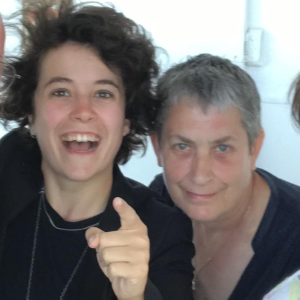
Rachel and Claire at a recent family party.
All LGBTQ+ children and young people deserve an education that reflects who they are. Join us in building a world where LGBTQ+ youth are safe, seen and heard. Stop the threats to LGBTQ+ inclusive education and donate today.
Find out about our campaign for LGBTQ-inclusive education.
A trailblazing new report from UCAS and Stonewall uncovers that nine out of ten LGBT+ students have a positive or neutral experience of the UK education system – and also shines a light on areas for improvement.
For many, higher education marks the beginning of a new period of possibility in their lives: freedom, independence, and an opportunity to find their place in the world. But for LGBT+ students, it also offers something greater– the chance to be their true selves. Today, a groundbreaking new report from UCAS, in partnership with Stonewall, looks into the experiences of the UK’s LGBTQ+ students preparing to start college and university for the first time. It shows that while there is still room for improvement, increasingly, our education system is seen as a space where we feel safe and free to be ourselves.
The report analysed responses from the one in 13 university applicants who declared they were LGBTQ+. Out of the nearly 3,000 students in that group, nine in ten reported positive or neutral experiences at school, with 75% saying this was due to them being accepted by their peers. Moreover, students indicated that they intend to be more open about their sexual orientation and gender identity in higher education, with overall levels of openness increasing from 64% at school to an expected 82% at university or college.
It’s heartening to see LGBTQ+ applicants be excited about being more open about their identity in higher education.
During a time of global uncertainty and disruption that has hit young people particularly hard, it’s heartening to see LGBTQ+ applicants be excited about being more open about their identity in higher education. But the study also highlights just how important it is for LGBTQ+ students to receive specialised support as they transition into further and higher education.
More than one in ten students stated they are unsure about how ‘out’ they can be when they start as freshers this autumn. One respondent replied: ‘I’ve faced a lot of transphobia and I don’t want to have to experience any more’, while another says: it’s personal and I still need time to find out for myself”. Others flagged that much depends on the attitudes of those around them.
The study revealed many new insights; LGBT+ students were more likely to declare a disability than non-LGBT+ students (30% vs 12%) and were more than four times more likely to declare a mental health condition (13% vs 2.9%). These figures rise to 47% and 22%, respectively, for trans students.
“At the turn of the millennium, teaching about LGBTQ+ subjects in schools was still illegal - this trailblazing research highlights the great progress made since then, with schools and colleges promoting LGBTQ+ inclusion", says Eloise Stonborough (she/her), Associate Director of Research and Policy, Stonewall.
There is still more we need to do to ensure all LGBTQ+ students are taught in an environment that allows them to fulfil their potential.
“As a result, we are now seeing LGBTQ+ students thrive, with more students feeling confident to be out at university. But the report shows that many lesbian, gay, bi, trans and queer young people continue to struggle at school. With under half of LGBTQ+ students (47 per cent) describing their experience at school or college as ‘good’ or ‘very good’, there is still more we need to do to ensure all LGBTQ+ students are taught in an environment that allows them to fulfil their potential.”
The study makes several recommendations to create an environment where more LGBTQ+ students feel supported and able to achieve their potential in further and higher education. One is to ensure that LGBT+ individuals have tailored and relevant support – such as information and advice, mental health support, and specific services on campuses. The Department for Education is also advised to continue funding dedicated anti-bullying initiatives – which were discontinued after March 2020 – to train school and college staff in England and provide support for pupils affected by homophobic, biphobic, and transphobic bullying.
It’s our hope that this study and its recommendations can make a crucial difference to LGBTQ+ students who deserve a supportive, welcoming experience throughout their time in further and higher education. You can download and read the full report below.
‘Whenever I remembered the treatment I’d had, I would start physically shaking,’ – survivors of conversion practices share their experiences.
Shockingly, conversion practices remain legal in the UK. And while this remains the case, LGBTQ+ people are at risk of harm. According to the Government's LGBT Survey, 7% of LGBT+ people have been offered conversion therapy, rising to 13% of trans people and 10% of asexual people.
Behind those cold numbers are real people – many of whom still carry with them the long-lasting emotional scars of being made to feel broken. Of being told that who they are is wrong, and that they need to be ‘fixed’ or ‘cured’.
Below, seven survivors share their harrowing experiences of this degrading practice – and the lasting damage it has had on them.
1. “The guilt around my sexuality is hard to shake.”
‘I went into total denial about my sexuality and embraced the idea that I had been “cured”. At the same time, my mental health bombed and my self-harm increased dramatically. In 2009, I tried to kill myself.
“It was only last year, aged 38, I finally accepted that I am gay. Even today, when I know that God loves me for who I am, the guilt around my sexuality is so hard to shake.’
George – a gay woman in her 30s
2. “It is still difficult to see how I am worthy of love.”
‘My pastor, along with his wife and a counsellor, did all they could to convince me that it was wrong to be trans. Even though I’m unsure what I believe anymore, I still live with the fear that I will go to hell.
One of the most destructive impacts was that I began to believe I was unlovable. After all, if I was being told that even God couldn't bear who I am, then it was, and sometimes still is, difficult to see how I am worthy of love.’
Liam – a trans man in his 30s
3. “I started to wonder if the therapist was right.”
‘It took years for me to seek mental health support again, in case the same thing happened. I started to feel hatred towards myself and a fear of engaging with people who might have supported me – whether that was the LGBT community or the South Asian community.
And I became insecure in my relationship. I started to wonder if the therapist was right: had I been used by my partner? Or groomed? That took a long time to overcome.’
Amir – a gay man in his 20s
4. “I have a difficult time with relationships, and intimacy scares me.”
‘Today I struggle with trauma, PTSD, and an eating disorder which are all linked to my conversion therapy experiences.
I have a difficult time with relationships, and intimacy scares me. A lot of people can’t comprehend what it’s like to have experiences like mine, even LGBT people. My parents still don’t understand why I didn’t want to have conversion therapy, or why it was so damaging. They think all therapy is a good thing.’
Eli – a gay man in his 20s
5. “I’d still have flashbacks from my sessions 40 years later.”
‘Whenever I remembered the treatment I’d had, I would start physically shaking. In that sense you could say that the therapy “worked”, in that it affected my body. But, in terms of my mind, and my thoughts, it only made me hate myself more.
The treatment didn’t stop, or even decrease, my feelings of dysphoria. I struggled with it for decades. It was only when I retired early – aged 55 – that I felt I could live openly as myself. And while things got so much better, I’d still have flashbacks from my aversion therapy sessions 40 years later.’
Carolyn – a trans woman in her 70s
6. “My therapy sessions put the shame and self-hatred I felt into overdrive.”
‘Conversion therapy stole precious time I could have spent exploring my sexuality, learning about myself, and building my relationship with my parents. At a certain point I thought I had become asexual, and this felt like an accomplishment.
It also took away my self-confidence. Because if I had truly believed that conversion therapy was right, what else was I wrong about? My therapy sessions put the shame and self-hatred I felt as a teenager into overdrive. I felt responsible for changing myself, and if I didn’t manage this, then I would have failed yet again.’
Joe – a gay man in in his 30s
7. “Dating has been impossible at times ... sometimes I have felt physically sick.”
‘My pastor taught me to be afraid of the secular world and even of Christians with more liberal views. I’ve also found it difficult to become part of the LGBT community, since I was taught to fear LGBT people.
Dating has been impossible at times – sometimes I have felt physically sick when starting a relationship because the feelings of “I shouldn't be here” come back so strongly.’
Emily – a gay woman in her 30s
Some names have been changed.
All of these stories can be read in full on the Ban Conversion Therapy website.
If you’ve been impacted by any of the issues discussed this article, visit the Ban Conversion Therapy website for a list of support services.
All LGBTQ+ people deserve to be protected from abuse. Find out how you can support a ban on conversion practices that leaves no one behind.
When I think about being Black and queer, the first thing that comes to mind is the incredible and intriguing presence that Black queer people have.
There is a powerful air of ownership, profound confidence, the bold audacity to reclaim the word queer and revel in our Black history. I think that comes after accepting our identity is still seen as an oxymoron in today’s society.
In my life, I’ve questioned whether I am Black ‘enough’ to occupy Black spaces, appear queer ‘enough’ to belong with the rest of the LGBTQ+ community – and if I am ‘enough’ of either in Black queer spaces.
For many Black people and people of colour, conversations around LGBTQ+ identities are still taboo in the family home and community – any acknowledgement of LGBTQ+ identities may be met with a disapproving side-eye, presenting the notion that we do not talk about being queerness. That we must hide it and keep it a secret.
The silence around LGBTQ+ identities within the Black community is a direct impact of slavery. After the abolition of slavery, formerly enslaved people faced an unemployment pandemic. In order to be accepted into a hostile society, Black people had to assimilate by being compliant, controlled and reserved. Today, we still see Black people being unlawfully killed by law enforcement – we are perceived as a threat because of our clothes, our music, or simply because we are Black.
It’s been passed down through the generations to keep your head down, stay out of trouble and most importantly, try not to be seen – because this could make the difference between life and death. But this has led to a devastating mindset: ‘We are already seen as different, why would you draw more attention to yourself by also being gay?’ As if being gay is a justified reason to be targeted.
All of this, along with a distinct lack of Black LGBTQ+ representation anywhere in society while I was growing up, has contributed to some of the problems I’ve faced. I was a late bloomer who came out at 24, using the label ‘bisexual’. For many years before that, I dressed ‘safe’, not too feminine, but not too tomboyish, butch or stud to raise any eyebrows. It was only after coming out and accepting my identity that I began venturing into LGBTQ+ bars, cabarets, and a wide variety of Pride events across the UK.
Even still, I was always conscious of biphobia and bi-erasure in LGBTQ+ scenes. I would be cautious about mentioning I was bi when dating either sex, for fear of rejection from predominately lesbian and gay-centric scenes, or fetishisation from straight cis men. It was only after researching more about Black queer culture that I discovered the term ‘queer’ – and with it a label I could confidently identify with. So, how does it feel to be Black and queer? D’antae Johnson explained it perfectly when they wrote: ‘A common misconception people have about Black queer people is that we must always be Black first. Personally, there is no first, both identities influence me equally.’
Although both parts of my identity are massively impacted by racism, homophobia and biphobia/bi-erasure, they also bring me so much joy.
Of course, I can’t speak for all Black queer people or queer people of colour. But for me, being Black and queer are synonymous. Although both parts of my identity are massively impacted by racism, homophobia and biphobia/bi-erasure, they also bring me so much joy. I want to acknowledge the incredible icons that have paved the way for people like me to forcefully take up space, celebrate our uniqueness and become leaders and role models within our own right.
The evolution of technology and accessibility of social media also means that today, there is a plethora of Black representation. There are more Black and Asian publishers, writers, lead actors, TV presenters, directors, and CEOs. We can showcase and recognise Black men like Lil Nas X, an astounding artist who perfectly incorporates gender fluidity in his music, videos, and fashion. There has been a surge of Black queer influencers on platforms such as TikTok, YouTube and Instagram, where our communities are able to thrive.
To be Black and queer is to be powerful.
It goes without saying that queerness is deeply personal. After all, the word ‘queer’ perfectly encompasses the intersectional experiences and fluid identities make us who we are. To be Black and queer is to transcend heteronormative and binary ideals. Most importantly, to be Black and queer is to be powerful.
Visit our Black History Month Hub.
October 11 is National Coming Out Day – but for most LGBTQ+ people, coming out is an ongoing process. In this essay, Stonewall’s Creative Manager, Max Hartley, describes their own journey towards coming out as trans.
I’m Max. And this National Coming Out Day, I’m coming out as trans. Getting to this stage has been a long and winding journey from childhood until today, at 28. For me, ‘coming out’ has taken a few different forms over the years – including tearfully telling my Mum I ‘wasn’t straight’ at age 14, letting university friends know I was a lesbian, and opening up about being non-binary when I started working at Stonewall a couple of years ago.
It’s easy to think that coming out several times means somebody is confused, indecisive, or that they will eventually identify their final ‘correct’ or ‘actual’ identity. But to me, feeling able to come out more than once has always reflected something positive about my own happiness and self-knowledge. It means I’ve learnt, accepted and started to celebrate something new about myself, and that I’ve built up the confidence to share it with the people around me.
The period before coming out to the people closest to me has always been characterised by fear and worry. Many LGBTQ+ people will have experienced this – struggling to sleep after hours spent considering the dozen ways a relative might react to your news – will they be proud? Anxious? Furious? We’re forced to confront the fact that no level of preparation on our side can ensure that we’ll be accepted for who we are. Coming out is always a risk.
LGBTQ+ people have to come out consistently; in different contexts and when they meet new people.
And it’s often said that coming out isn’t a one-time thing – in fact, LGBTQ+ people have to come out consistently; in different contexts and when they meet new people. Because stereotypes and strict categorisations about LGBTQ+ people are still commonplace, some people find that they’re always assumed to be straight or cis. Often bi people are assumed to be straight or gay, depending on their partner. Having to come out simply to correct other people’s incorrect assumptions can be exhausting, particularly if it’s happening regularly and your identity hasn’t changed.
But under better circumstances – when you have news you’re excited to share – coming out can be transformative. Getting the chance to live more authentically means that many LGBTQ+ people see coming out as a major milestone in their lives. And while not every coming out conversation I’ve had has made me feel celebrated in the moment, afterwards I’ve always felt liberated, relieved, and proud of myself for taking a leap of faith.
Personal circumstances also play a crucial role in determining whether you feel able to come out, and to what extent. I knew I was non-binary long before I told anybody outside my close friendship group. I used to work in an industry that prides itself on inclusivity, but where I felt I’d be more widely accepted as a gay person than a trans person. So when I was read as a lesbian, I didn’t contradict my colleagues. I knew that coming out as non-binary would lead to more than a few awkward conversations and a mishmash of pronouns that would have made me feel more embarrassed and self-conscious than sticking with a label that is widely understood. Deciding who to be out to, and when, involved constantly weighing up the potential risks and rewards.
I was finally able to reflect on what it would mean not just to be ‘fine’ with my body – but to like it.
And when the pandemic hit, my circumstances, like everyone’s, changed again. Being furloughed gave me more time to think about myself and my future than ever before. Without the usual distractions, I was finally able to reflect on what it would mean not just to be ‘fine’ with my body – but to like it. And to admit that, in order to get there, I wanted to transition medically.
Just over a year ago, I was prescribed hormones. I had support from my close circle, and took courage in the fact that I could stop taking testosterone at any time. Trans people are constantly warned that they could regret medical transition and cause ‘irreversible damage’ to their bodies. And, despite the evidence of happy trans people all around me, some of those pervasive narratives were still lodged in the back of my mind.
I still came out slowly, taking each obstacle one at a time, and gradually introducing my new name.
But in a surprise to probably no one, I didn’t regret anything. Seeing changes in my face, body and voice didn’t make me feel alienated from myself – they made me realise that I’d been feeling alienated from my body since puberty and had simply learnt to cope with it. After that, coming out became easier – but I still did it slowly, taking each obstacle one at a time, and gradually introducing my new name. I waited six months after starting hormones to tell lots of people, because I wanted to be armed with an explanation as to how I could be ‘sure’ that medical transition was right for me.
Today, I’m coming out to the rest of the world as trans because I feel ‘sure’ – or ‘sure enough’. Lots of LGBTQ+ people will relate to this need to feel certain that their identities will stick – that they’re not a ‘phase’ – before they come out. But I hope this won’t be the yardstick for future generations. I hope that LGBTQ+ people can come out, as themselves, as many times as they wish. And that in future we’re able to embrace our identities whether they’re static and final, or shifting and fluid – and be met with a rapturous reception when we do.
Visit our Coming Out hub.
I’m usually not one to follow the latest music videos, but Lil Nas X has changed that.
There’s so much to dissect in videos for songs like Montero and Industry Baby – namely that he’s an openly gay young male showing his femininity and being dark skinned all at once. And yes, the tone of his skin matters.
The Black community has a different relationship with sexuality and its politics, which has been heavily influenced by the European colonial history. This includes having to deal with sexual violence and being forced into the binary thinking, and behaviour, that characterise white supremacy. In the article ‘Anthropologists Hid African Same-Sex Relationships’, Livia Gershon states the following about how Europeans viewed Black male love:
Way back in the sixteenth century, Epprecht writes, Europeans did report sexual relationships between African men—generally in horrified terms […] an English traveler wrote that the Imbangala of Angola were “beastly in their living, for they have men in women’s apparel, whom they keepe among their wives.”
Using words like ‘beastly’ to not only describe African men – but also African love – gives a clear insight into European patriarchal ideals. Within that structure, if you are born with certain genitals, you are assigned one of two genders and have a duty to perform your given role within society.
Along with men being the ‘head of the household’, their assumed testosterone allegedly makes them unable to ‘help’ their heightened anger and violence – it is inbuilt. Women have a ‘lack’ of testosterone and must control their own behaviour to ensure they don’t cause men to act violently. When it comes to race, African and masculine people are characterised as having higher testosterone – and therefore being even more prone to anger and violence.
So, when Lil Nas X showed his femininity and gayness in all this dark-skinned majestic Blackness, with no shame, he was met with inevitable pushback. It meant that he was demeaning what cis heterosexual Black men and women worked so hard for: a nuclear, cis, straight family, fully Black and fully proud. But did they not see this idealised concept originates from patriarchal, European politics?
The debate around Lil Nas X made me think a lot about my journey with my masculinity in this Black female body.
The debate around Lil Nas X made me think a lot about my journey with my masculinity in this Black female body. When I told men both Black, white and all between that I was gay, the only ones who saw it as a threat were white. The others praised me – I was ‘one of them’ because they thought I had left my femininity behind.
‘We need to go out and get [women] together.’
'You can be my wing woman, because I don’t know how to talk to ‘these females’, I was told.
I know that other masculine of Centre people have had vastly different experiences to mine after coming out – around the world, hate crime has been rampant these last years. But in my case, I was left with the question: why were non-white men happy for me after assuming I had lost my femininity? And why did white men start to see me as a threat? Is it because within the non-white world, femininity is seen as a disgrace? And within the white world, besides my race, my female body had to perform my gender, if not, it was seen as dangerous?
I truly believe that once Black Lives Matter includes Queer and Trans lives, it will give more space to heal from the White cis-hetero sexual patriarchy. Besides this, safety can truly emerge and exist outside of the system which is currently focused on the mind instead of the body. In the process of decolonizing the body and mind, people forget that sex and gender are at the center of this. You cannot decolonize the mind, but still believe in two genders or decolonize sex and assuming that sex is binary, not bimodal which excludes many people who are intersex.
Our predecessors laid the foundation of what it means to feel at home in our Black bodies – but this was often in answer to, and through the gaze of, whiteness.
Our predecessors laid the foundation of what it means to feel at home in our Black bodies – but this was often in answer to, and through the gaze of, whiteness. While I believe that true healing was always the end goal for some Black people, the systematic oppression and continuing murders of Black people meant that all too often we have had to focus on just one thing: survival. But the fact that some Black queer and trans people managed to live and thrive is the reason Lil Nas X can do what he does so beautifully today. He shows us just how powerful it can be when we cast aside the gender roles society has tried so hard to place upon us.
I believe that this generation is ready to show the diversity of Blackness outside of the white gaze and more through its true African ancestry. Where there’s reemerging understanding that we move with the world, instead of centering it around us and understand that to live freely is to express yourself freely, without shame and guilt. That just like emotions, gender comes and goes – and the only way to understand it is to observe it, live it, experience it, freely.
References
Boihood, B. (2016). Outside the XY: Queer Black and Brown Masculinity . Riverdale Avenue Books.
Gershon, L. (2019, July 5). Anthropologists Hid African Same-Sex Relationships. Retrieved from Jstor Daily: https://daily.jstor.org/anthropologists-hid-african-same-sex-relationships/
James, A. E. (2011). Queer Like Me: Black Girlhood Sexuality on the Playground, Under the Covers, and the Halls of Academia. Journal of Lesbian Studies.
Visit our Black History Month Hub.
Conversion practices are a damaging and degrading practice that tries to change, "cure", or suppress people's sexual orientation and/or gender identity.
It leaves lasting scars on LGBTQ+ survivors – but not everyone fully understands what it is. Below, we look at seven things about the practice that you might not know about.
1. It’s still happening in the UK
Conversion practices aren't a thing of the past. Since conversion practices are still legal in the UK, it can – and does – still happen to LGBTQ+ people today, often preying on those who are most in need of support and community.
2. It can take many forms
The term ‘conversion practices’ covers a vast array of pseudo-psychological practices, from talking therapies – that encourage a person to believe that their sexual orientation, gender identity, or gender expression is somehow wrong, disordered, or potentially ‘sinful’ – to physical abuse, beatings, or the use of so-called ‘corrective rape’.
3. It’s more prevalent than you might think
Conversion practices impact more people than you’d think. In fact, 7% of LGBTQ+ people in the UK have been offered or undergone conversion therapy.
4. It impacts people of all ages
While you might think that only people from an older generation are exposed to conversion practices, this isn’t at all the case. People of all ages can – and often do – experience it.
5. It impacts some groups more often than others
LGBTQ+ people of colour are twice as likely to undergo conversion therapy, trans people are nearly twice as likely to be targeted, and asexual people are also at higher risk.
6. It has a significant and long-lasting impact on survivors
While no study has ever determined that conversion practices are successful, there is significant evidence that it can be fatal, and survivors carry the resulting trauma throughout their lives. A 2024 study found that nearly 1 in 6 (16%) LGBTQ+ young people reported being threatened with or subjected to conversion practices, and this was associated with higher rates of mental health concerns.
7. Seeking support can seem impossible
For those who have experienced conversion practices, speaking out and seeking support can seem impossible. The trauma they’ve endured and the fear of upsetting their families or communities will mean that many will keep their pain to themselves and face it alone. It doesn’t have to be this way – but we need the Government to implement a full legislative ban and provide support for victims and survivors.
All LGBTQ+ people deserve to be protected from abuse. Find out more.
National Coming Out Day was first celebrated in 1988. Over 30 years later, it’s still in our calendars – but why do we need it?
National Coming Out Day is an annual celebration which takes place on 11 October every year. It was first celebrated on the one-year anniversary of the 1987 National March on Washington for Lesbian and Gay Rights – a date chosen to honour the bravery of LGBTQ+ individuals who decide to come out and live openly. Although it started off as an American awareness day, the meaning of National Coming Out Day is still highly relevant to LGBTQ+ communities across the world today.
Coming out is a unique experience for each LGBTQ+ person. It’s not a one-time event; many LGBTQ+ individuals who come out to their closest friends and family may later come out at work or school, to their extended family, or to casual acquaintances.
For some, coming out is no longer a big deal – it can be a simple matter of correcting someone’s assumptions about you, or introducing your partner. For others, coming out is still a huge challenge. The very real fear of facing discrimination, bullying, or judgement can cause LGBTQ+ people to stay ‘in the closet’, struggling with anxiety while they strive to be themselves.
While coming out can be daunting and scary, it can also be the first time that LGBTQ+ individuals are able to be truly open with the people closest to them.
Talking about coming out and sharing our stories can help to strengthen our community and support one another with this experience. While coming out can be daunting and scary, it can also be the first time that LGBTQ+ individuals are able to be truly open with the people closest to them.
Over the last few decades since National Coming Out Day was first recognised, we’ve seen huge progress for the LGBTQ+ community, with legislation on same-sex marriage, discrimination laws, and educational reforms all helping to protect and support LGBTQ+ people.
However, these legal developments don’t mean that the fight for LGBTQ+ rights is over. In the UK, we continue to see LGBTQ+ people suffer from attacks, hate, and abuse. Across the world, LGBTQ+ people are still campaigning for laws and attitudes alike to change. For many, coming out can be dangerous – or simply not an option.
National Coming Out Day isn’t a day to force LGBTQ+ people to come out, or to shame people who haven’t done so. It’s a day to celebrate the beauty of being true to yourself, for having the courage to share an important part of your life with others, and for celebrating those who may come out to you. Rather than being perceived as exposing yourself or confessing something, we should see coming out as a marker of coming into your identity, and allowing others to share in that knowledge. National Coming Out Day should also be a day to acknowledge the difficulties of coming out, and to remember that it’s still not something all LGBTQ+ people can safely do.
Today, some would argue that coming out (and having a day to celebrate it) is unnecessary. It’s true that no one should have to come out, and that not coming out doesn’t mean that you’re “hiding” or “lying”. In an ideal world, being straight and/or cis wouldn’t be perceived as default, and no one would make any assumptions about anyone’s sexual orientation or gender identity.
But for so many in our communities, that day is still a long way off. Coming out has always been an important part of LGBTQ+ history.
For those who are questioning their identities or living in an unwelcoming environment, seeing someone come out – whether it’s a YouTuber, a family member, a teacher or your best friend – can offer a feeling of hope, solidarity, and reassurance.
Celebrating National Coming Out Day is an important way to raise the visibility of our communities.
Whether you identify as LGBTQ+ or an ally, celebrating National Coming Out Day is an important way to raise the visibility of our communities: reminding us all of the ongoing struggles LGBTQ+ people face just for being themselves, but also of the joy and pride of being openly LGBTQ+.
Read more on coming out.
In partnership with ERA (LGBTI Equal Rights Association for the Western Balkans & Turkey), Stonewall is launching You Are Heard, an LGBTQI+ hate crime reporting website.
This new service provides a safe space for LGBTQ+ people and allies to report incidents.
How does it work?
You Are Heard has been developed with expert civil society organisations to allow individuals to report anti-LGBTQI+ incidents, such as harassment, violence and hate speech.
Users can remain anonymous when reporting, or add contact information if they wish to receive support from trusted local LGBTQI+ organisations. Individual reports won’t be shared with the police or governmental bodies – instead, local LGBTQI+ support organisations will receive the information and data to manage and analyse. They’ll then lead on advocacy work across local regions within the Western Balkans and Turkey.
The anonymous statistics created from the data will be used to show governments and policy makers which policies and support systems for LGBTQI+ communities must be introduced or improved. Crucially, the website has been built with the safety of LGBTQI+ individuals in mind, so that users making reports can be sure that their personal information will remain private.
How will this help?
By creating a strong bank of evidence on hate crimes against LGBTQI+ people, advocacy groups will be empowered to create meaningful changes in legislation at a governmental level. We also hope that members of the LGBTQI+ community feel confident using You Are Heard to report incidents, since the platform will provide routes for survivors to access support in their area.
Stonewall and our partners aim to access further funding in the near future in order to maximise the impact of the platform. We plan to introduce enhanced digital functionality and further resourcing of advocacy work across the region, meaning the LGBTQI+ community will see further benefits as the platform grows.