
Blog
I teach in a large secondary academy in Derbyshire. As a safeguarding lead, I receive a high volume of concerns from staff and parents about our students.
This can involve anything from feeling low to experiencing family issues, mental ill health and self-harm. To make sure I can do the best for my students, I’m always looking for opportunities to improve my understanding of our young people and how I can improve their life chances.
This is what led me to attend Stonewall’s ‘Creating a trans-inclusive school’ course in Nottingham. I had attended LGBT inclusion courses in the past, but this one was different.
At the time, I felt that it was still quite taboo to talk about LGBT matters in schools, but we were seeing an increasing number of young people struggling with identity, gender and sexuality issues, and feeling that they didn’t have a voice.
I was also struggling to signpost parents and students to appropriate sources of advice and support because we had limited knowledge around what kind of help was out there.
I was anxious prior to the training – I worried about having only basic knowledge and terminology, but I never felt alienated or foolish.
The training helped me reflect on the changes we needed to make at school, and I felt a real buzz as I began to think of practical ways that we could adapt our environment.
When I returned to school, I began by looking at our library. I was surprised to find there were no books focusing on LGBT characters or themes. With help from our LGBT club (Rainbow Alliance), we created a notice board that was displayed centrally in school, which displayed LGBT icons and posters.
I met the headteacher to discuss rolling out assemblies to all students explaining our vision of a school where everyone feels equal and valued. I updated the anti-bullying policy to include homophobic, biphobic and transphobic bullying.
I also trained my colleagues on LGBT inclusion. This was challenging at times, but I always linked it back to the young person, reminding staff that we should be having open and honest conversations with our students and liaising with their parents/carers.
I felt that, due to my training and the extra reading I took on after the course, I was equipped to answer my colleagues’ questions.
It took 6-9 months to make the changes I wanted to make, so I was very proud when our school achieved the Bronze Stonewall Award.
I am happy to say we now have LGBT books and an LGBT section in the library, although it stills needs expanding. Staff now know how to challenge homophobic, biphobic and transphobic behaviour, and record it as such on monitoring forms.
When I started speaking to my students about LGBT matters, I was surprised to see how much they were already aware of.
We’ve also had some great positive feedback about the fact that we have these conversations in school.
I also took it upon myself to find out what is local to us in terms of LGBTQ support for young people. This meant that when one of my year 11 students was struggling with depression and being accepted as gay in his community, I could seek support from an LGBT youth centre nearby.
There’s still more LGBT inclusion work that I want to do, such as welcoming LGBT guest speakers, ensuring that LGBT resources are being widely incorporated into the curriculum, and sharing my skills and knowledge with other schools.
But thanks to Stonewall’s course, my school is now well on the way towards being an environment where everybody feels free to be themselves.
Harmi's school have benefitted from Stonewall School & College Champion membership, with access to our expert support and advice, a growing library of guidance resources and lesson packs, and discounted training as well as the highly sought after Bronze, Silver and Gold Awards. Find out more about Stonewall's membership scheme for schools and colleges.
Today, Stonewall launches a report from the Out of the Margins network.
Between February and September 2019, the network documented the profound exclusion facing lesbians, bi women and trans (LBT+) people, showing the hardship, discrimination and violence experienced by their communities across the globe.
The network built through the Out of the Margins project spans 21 countries. Using the United Nations’ 17 Sustainable Development Goals (SDGs) as a template, they produced research covering five key areas: economic well-being, health, education, personal security and violence, and civic and political participation.
Watch the video to learn more about the project.
The network demonstrates the many ways in which LBT+ communities are discriminated against and how their needs are refused, ignored and/or unmet.
At the heart of this project and network is the desire to bring wide-ranging and meaningful change to LBT+ people, both in their own countries and internationally.
A crucial feature of the project was the direct involvement of marginalised LBT+ people in the research, and in the action affecting them and their communities.
Intersectional, feminist and queer perspectives were prioritised from the outset, in order to amplify voices that have been unheard or ignored in previous research projects.
Some findings will be challenging to read – throughout the report there are descriptions of violence and abuse. However, we believe that the discrimination faced by LBT+ people must be acknowledged if meaningful change is to be made.
The voices of the research respondents in this report show just how vital it is that Out of the Margins network members are able to continue with their essential work.
Nancy Kelley, Chief Executive at Stonewall, said: ‘This groundbreaking report shines a light on lesbian, bi women and trans (LBT+) communities across the globe whose struggle for equality continues to be largely ignored. Not only does it show the precarious position LBT+ people occupy worldwide, it’s also a testament to their bravery and the work they’re doing on the ground to tackle discrimination, often at considerable personal risk. At Stonewall, we’re working with these international activists to help fight for equality in their countries, and we want you to join us.'
The more research there is about the barriers these LBT+ communities are facing, the better able we are to come together to drive forward solutions that work for them. No one can be left behind in our fight for global LGBT equality. - Nancy Kelley, Stonewall CEO.
Download the full report here.
If you want to help, donate to the individual organisations that developed the research or support Stonewall.
As Northern Ireland celebrated its first same-sex marriages in January this year, we rejoiced in having made marriage equality a reality throughout the UK.
But, that’s not quite the case. In the Cayman Islands, a British Overseas territory, same-sex marriage is still banned, as it is for many British Overseas Territories. And in many there is no legal recognition of same-sex partnerships at all.
Last week (27th July 2020), we were concerned to hear that the Cayman Islands’ legislature failed to pass the Domestic Partnerships Bill, meaning that same-sex couples cannot have their relationship recognised by the state.
This is despite the Cayman Islands Court of Appeal ruling that the Cayman Islands Government must legislate for same-sex partnerships to meet its Constitutional duties.
Same-sex marriage is still banned in many British Overseas Territories.
Same-sex marriage is still banned in many British Overseas Territories.
Civil partnerships and marriage equality have been key milestones in our journey towards LGBT equality in the UK. There have been many other vital steps (and many more we need to take), but to have the state recognise your relationship as equal to any other, has enabled us to live more confidently and freely in our communities, at work and in every part of our lives.
At the time of their engagement, the Cayman Islands banned any form of legal union between same-sex couples.
That’s exactly what Chantelle Day and Vicky Bodden Bush wanted for themselves.
They have been together for nearly seven years, and got engaged in September 2017, but they quickly realised that because Chantelle was from the Cayman Islands – a British Overseas Territory – their relationship didn’t exist in the eyes of her government. At the time of their engagement, the Cayman Islands banned any form of legal union between same-sex couples.
The couple was faced with an impossible choice: to either get married in the UK and return to the Cayman Islands where their marriage wouldn’t be recognised; or stay and fight for the right to marry the person they love in the place they call home. With support from friends, including local LGBT advocacy group Colours Cayman, they decided to fight for themselves and for every other same-sex couple denied equality in Cayman.
Their initial application for a marriage licence was swiftly rejected.
But they didn’t give up and on 29 March 2019, they, along with the rest of the global LGBT community, celebrated as the Grand Court of the Cayman Islands ruled to legalise same-sex marriage with immediate effect. The Court concluded that the ban was not compatible with the couple’s rights under the Cayman Islands constitution or the European Convention on Human Rights, which has effect in British Overseas Territories because the UK Government is a signatory.
Thewas postponed following an interim court order.
In November 2019 the Cayman Island Government won their appeal to overturn the legalisation of same-sex marriage. But the Court of Appeal also said the Government was causing undue pain and suffering by not recognising Chantelle and Vicky’s relationship on an equal basis to marriage, and directed the Cayman Island Government to immediately legislate to offer civil unions which have a ‘legal status equivalent to marriage’ for same-sex couples.
Last week’s vote stopped this legislation from progressing, putting the Cayman Islands Government in clear breach of its own Constitution.
It is time for the UK Government to step up.
It is time for the UK Government to step up.
In their judgment last year, the Cayman Islands Court of Appeal said: ‘In the absence of the expeditious action by the Legislative Assembly, we would expect the United Kingdom Government to recognise its legal responsibility and take action to bring this unsatisfactory state of affairs to an end.’
Now that the Domestic Partnerships Bill has failed to pass, the UK Government must step in and ensure that citizens in the British Overseas Territory of the Cayman Islands are not denied the rights enjoyed by British citizens in the United Kingdom.
Many of the laws that exist in the British Overseas Territories are there because of anti-LGBT colonial laws introduced by Britain in the last two centuries. Despite self-rule, in the Overseas Territories the UK still has jurisdiction and a duty to LGBT citizens in those territories who are denied equal rights and equal treatment.
In fact, the courts in the Cayman Islands have made clear in their judgments that the UK is in breach of the European Convention on Human Rights in allowing this unequal treatment to continue in the Cayman Islands and other British Overseas Territories.
We should all have the right to marry the person that we love, and no one should be left alone in this fight. We stand in solidarity with the Day-Bush family and their supporters in Cayman and the UK. Now is time for the UK Government to act and fulfil its duty to LGBT citizens in all British Overseas Territories.
Today, the Equality and Human Rights Commission published a new report on public attitudes to trans people – drawing on data from the British Social Attitudes Survey.
At the moment, trans people’s lives are an almost constant part of our media narrative. But while the media can help reflect societal views and trends, it doesn’t give us a true impression of how people are thinking and feeling about things in real time. That’s why this data is so important.
So, what does it tell us?
Well, this data confirms a lot that we already knew. The first is that public attitudes to trans people are broadly positive. When asked about transphobia, we can see that transphobia is seen as ‘A Very Bad Thing’, and women, young people and people with higher educational qualifications are all more likely to feel positively towards trans folk.
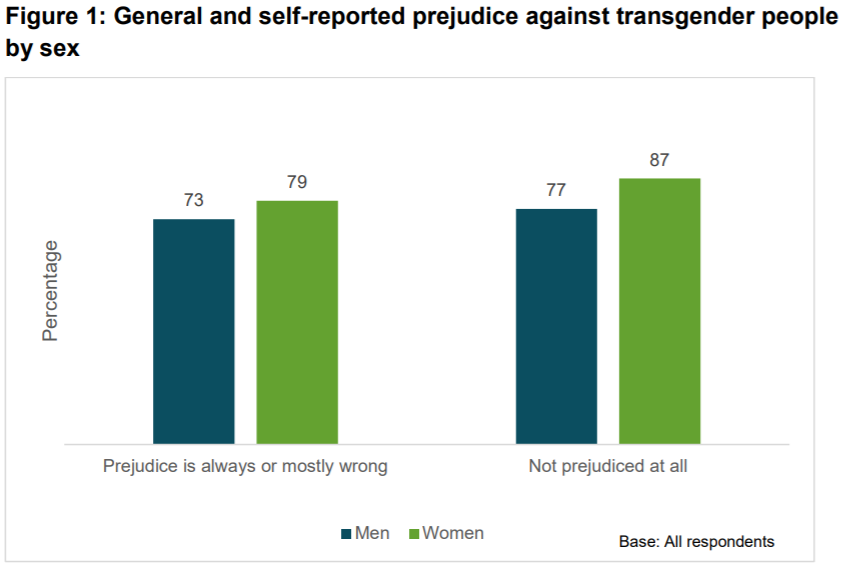
Secondly, high level attitudes appear not only positive, but also stable. This means that this positivity is not new, nor is it fragile. In 2017, 76% of people said that prejudice against transgender people was ‘always or mostly wrong’, compared to 76% in 2019 – so this has stayed consistent. While the proportion of people who describe themselves as ‘not prejudiced at all’ against trans people has risen, to 84% now, compared with 82% in 2016.
The proportion of people who describe themselves as ‘not prejudiced at all’ against trans people has risen.
Encouragingly, these positive attitudes hold up pretty well in real-life scenarios. The vast majority (84%) of people think properly qualified trans people should be able to work as police officers, and three quarters of us (75%) think trans people should be able to teach our children in school. This matters: these are the professions that the public sees as important and trustworthy, so accepting trans people into these roles is a great indicator of social acceptance.
However, there is some more concerning data, which suggests that in some areas, the public have become a little *less inclusive in recent years. While most of us, particularly women, continue to be comfortable with trans women using single-sex spaces like toilets and domestic abuse refuges, the data shows us a worrying downward trend.
The biggest change is in attitudes to trans women in refuges, where now just 51% of the population are comfortable (compared to 61% in 2016) and 24% are uncomfortable (compared to 16% in 2016). Contrary to common anti-trans narratives, these views are not driven by fear - only 1% of women are scared of trans people. So what we’re seeing is that the incessant and largely negative media coverage on these issues is likely starting to negatively impact and influence people’s attitudes.
If that’s what we *think, how do we *feel ?
So we know that a very small percentage of people fear trans people. But other than fear, how do the public feel about trans people?
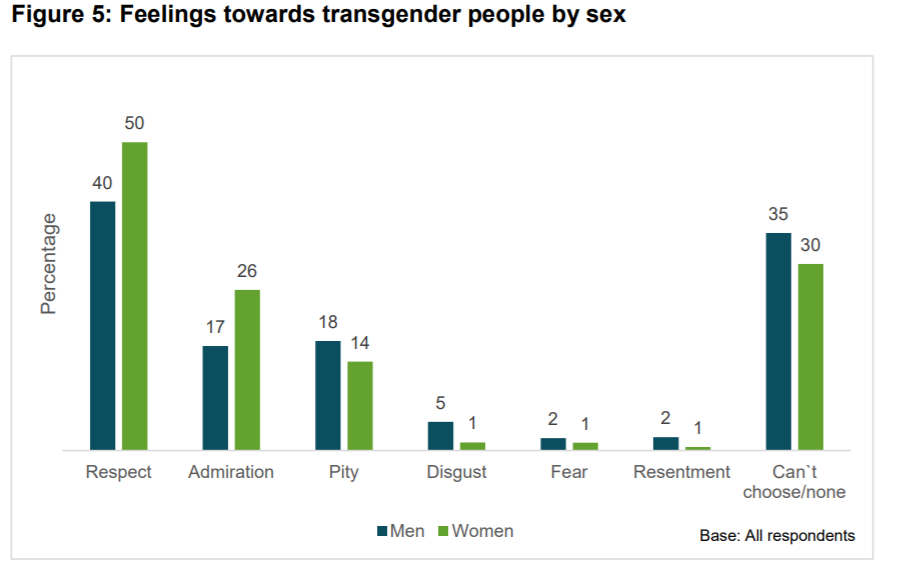
When the public is asked to choose words that describe their *feelings towards trans people, we see a really striking picture.
Overall, positive feelings dominate, particularly for women – half of us feel ‘respect’ and more than a quarter ‘admiration’ for trans people. We can also see that women are much more likely to feel respect and admiration for trans people, while also being less likely to feel disgust, pity, fear or resentment. This is important to bear in mind, as it undermines the common narrative which seeks to turns cis women and trans women against each other.
Positive feelings dominate, particularly for women.
But alongside these positive feelings, quite a lot of us aren’t sure and that’s OK. Some of these people may not be comfortable expressing negative feelings, many of these people are likely to be those who genuinely don’t know how they feel, or simply see trans people as ... people.
Very few people indeed selected negative feelings such as disgust, fear or resentment. But when we look at the views of the minority who describe themselves as prejudiced (16% of us), this transphobic minority feels very strongly: a third said they felt disgust (33%) and one-quarter said that they felt resentment (25%). This means that while the group of people who are transphobic, and would describe themselves as such isn’t large – 16% is in line with other forms of discriminatory attitudes to oppressed groups – the views of that minority are much stronger.
What does this all mean?
Firstly, this data demonstrates *yet again* that the public ‘debate’ on trans rights and trans lives is not in line with public attitudes. The British public in general, and British women in particular, feel pretty positive about trans people. If our media coverage and social media discussions simply reflected this reality, the lives of trans people would be immeasurably improved overnight. Instead of this, the drip, drip of negative and distorted media coverage may be manufacturing a creeping sense of discomfort around shared spaces.
And secondly, it shows that we have a small, but vocal group of people with extreme anti-trans views in Britain, and that should worry us all.
The Government Equalities Office estimates that there are between 200,000 and 500,000 trans people in the UK, in a population of more than 66 million. We need to make sure our trans family, friends and neighbours feel safe and welcome, and we need to hold family and community members, leaders and journalists to account for how they engage with the trans community.
If the majority of us simply sit by while the transphobic minority shout their harmful views from the rooftops, our warm feelings mean nothing, and we are part of a problem that is ruining trans folks lives.
If you see people sharing misinformation about trans people, challenge it.
Now is the time to act. If you’ve not done this already, call, email or meet with your MP and explain to them the importance of legal recognition for trans people. If you see people sharing misinformation about trans people, challenge it. And if you see abuse on social media, report it. We know that the public feel positively about trans people, now it’s time for trans people to feel it too.
‘We need, in every community, a group of angelic troublemakers’ – Bayard Rustin
What is butch? Traditionally, in lesbian culture, the word ‘butch’ refers to a woman whose gender expression and traits present as typically ‘masculine’.
Being butch is about playing with and challenging traditional binary male and female gender roles and expressions. The contemporary Western idea of butch gained a formal identity in 1940/50s American underground lesbian bars, where the butch/femme dynamic both mirrored and subverted the expected gender norms of mainstream society.
Yet butches have been around, challenging societal understandings of gender roles, across cultures and throughout history.
Butch is not just one thing, as most queer cultures across the globe have their own variation of the term specific to their own social context (such as location, race and class). Some of the more recognisable terms include: Masculine of Centre, Stud, Boi, Soft Butch, AG, Dyke, Stone butch, Daddy, Tomboy, Camionera, Futch, Stemme, Top.
Butch can mean many things to other LGBT subcultures as well, but today, to talk about what butch means to me, I’m looking at it as a cis lesbian woman.
Being butch isn’t just about clothing and presentation.
But being butch isn’t just about clothing and presentation, it can also be about lifestyle and taking on ‘masculine’ roles and careers – or jobs which in their time were thought of as ‘male’.
Anne Lister is an example of this, and the subject of recent BBC period drama, Gentleman Jack. She was a 19th century landowner, industrialist and adventurer, whose diaries recorded her relationships with multiple women. She presented in male clothing and occupied male spaces afforded to her by her wealth and social standing.
There are historical records of other women who lived outside of people’s expectations of them, including seaman William Brown, a Grenadian sailor who reportedly served in the Royal Navy for 11 years before being discharged for in 1815 for ‘being a female’.
There is also a tradition of female husbands, recorded in many precolonial African tribes such as the Igbo of Southeastern Nigeria, the Zulu of Southern Africa, the Nuer of East Africa and the Nandi tribe of Kenya. They were, to varying degrees, afforded the same rights and standing as men within certain male-dominated cultures, occupying leadership positions, owning land, amassing wealth and taking wives of their own. For some this meant adopting male clothing, mannerisms and titles.
As a black African woman, my butchness used to be something restrictive, and it further compounded the complex elements of my identity that were created by moving from an African to a Western society. As a masculine presenting person, this was a misinformed method of holding on to my history and traditions. I believed I had to be dominant, resilient, reserved, stoic, and muted, perpetuating ideas around African machismo appropriated from the male figures around me who themselves had a fraught relationship with their own masculinity.
I had a damaging understanding of what masculinity was, which led me to reject anything feminine because I associated it with weakness, fragility and being docile - all things I perceived as negative.
It wasn’t just about being masculine, it was about being an alpha male and embracing harmful stereotypes of what a man should look like, because even though I wasn’t one, I wasn’t that kind of woman either. I was trying to mould myself into ideas and a culture that wasn’t necessarily good for anyone. It was not designed for me and actually, my butchness posed a direct threat.
I am discovering that being butch isn’t about fitting into expectations, it is about shattering them.
I recently read an interview with Tabitha Benjamin, who runs trans-inclusive lesbian club night, Butch Please, where she stated, ‘Butch, for me, is nothing to do with being masculine. It’s actually something about being really feminine, about identifying as a woman’. This really resonated with me.
While I still have an extensive blazer, brogue and bowtie collection, increasingly I am playing with colour, patterns, feminine clothing, jewellry, make-up, traditional African clothing, and how to embody butchness while still wearing a pair of hot pink ‘pum pum’ shorts.
Butch, for me, has previously been about how I am perceived, something that’s out of my control, a label imposed upon me. I am now claiming autonomy over that. Sometimes I find it funny that people think of me as butch at all. I wear “boy clothes” and have short hair, so I guess I can see why if we’re oversimplifying things, but I am finally able to embrace being a flamboyant flouncing camp sissy dyke too. I am discovering that being butch isn’t about fitting into expectations, it is about shattering them with the heel of my glitter Doc Martens.
Increasingly, it’s becoming more important to appreciate, represent, celebrate and protect butch identities.
As with any identity that challenges expectations, butch people can often receive antagonism or backlash for simply being themselves.
This can be in the form of verbal or physical attacks, being repeatedly and pointedly called ‘sir’, being challenged in bathrooms or told to stay out of ‘female spaces’.
All of these things have happened to me, and I’m sure they won’t be unfamiliar experiences for many other butch people.
This is what happens when people try to apply narrow and inflexible definitions of what ‘womanhood’ is. Most of us will never fit into that mould; we were never meant to and as long as it is something that is used to oppress rather than allow freedom - I, personally, have no desire to fit in.
Today, butchness to me means strength.
Today, butch to me means strength. It means standing up for what I believe in and protecting those who need it, when they need it.
It means knowing when to stand aside and support, resisting, trailblazing, nurturing, learning, growing, being emotional, being vulnerable, and laughing.
All these things have been embodied by the strongest womxn I know, butch or otherwise, and it’s linked directly to their womanhood. Butch to me does not mean simply ‘masculine’, it is a complex and empowering expression of identity. It is a badge that I wear with pride, thanks to other incredible womxn, all who have proudly worn their own butchness on the lapel of their blazers before me.
Sport has the power to change lives.
From kicking a ball around in the park at the weekend to elite competition, sport at all levels helps people come together, work as a team, push themselves, and achieve amazing things. Lesbian, gay, bi and trans people should all have the opportunity to be part of sport, and we surely have a lot to offer to the sporting community.
Right now, many LGBT people feel unwelcome in sport, often from an early age, with bullying and harassment driving some people away permanently. Yet many of us do love sport, often in spite of these challenges. There is a growing LGBT movement within sport, challenging cultures and policies that exclude us, and campaigns like Rainbow Laces have created a powerful platform for change. New research shows that these campaigns work, and at Stonewall we’re proud to work with many leading sports organisations and governing bodies on the hard yards needed to make LGBT inclusion a reality.
Our research shows that despite the progress we’ve made, discrimination is still a serious problem for LGBT people in sport, feeding a wider sense that LGBT people are not welcome. These findings are particularly stark for trans people, including non-binary people. Three in ten trans pupils (29 per cent) report being bullied during PE lessons and two in five trans people (38 per cent) say they avoid going to the gym or participating in sports groups because they fear of discrimination and harassment.
But for all these negative experiences, many trans people do take part in sport, and are valued members of their teams, clubs and communities. Most governing bodies in sports have rules to support trans inclusion and have done for many years.
There has been lots of discussion recently about trans people in sport, with trans women being a particular focus. Everyone deserves to be safe playing their sport. Everyone deserves to be welcome and respected playing their sport. A heated ‘debate’ on social media is not how any important policy should be made.
Rather, decisions on guidelines should be informed by robust evidence and developed in consultation with players and athletes with direct experience. No two sports are the same. The physical and tactical skills and attributes needed for different sports are highly varied, as is the profile of players competing across grassroots and elite levels. It’s vital that when they make decisions on inclusion, sports bodies like World Rugby use data that is high quality and specific to both the sport and the level at which the game is being played. Given that rugby is currently trans inclusive, it’s also vital that they consider the experience of trans inclusion in the sport to date.
There has never been a more important time for sport to bring us joy, together.
Inclusion is already the starting point for most people involved in sports, because they love sport and want to make their sport everyone’s game. As sport policymakers work to grow the sports they love and participation rates falter, addressing the substantial barriers to participation that LGBT people face is critical. COVID-19 has taken a huge toll on LGBT communities mental health and health - there has never been a more important time for sport to bring us joy, together.
That’s why I am looking forward to the Rainbow Laces campaign later this year. I’m looking forward to the joy of hundreds of thousands of fans and players wearing the laces, celebrating the great work on inclusion that’s already happening with partners like the Premier League, and inspiring others to step up their work to make sport everyone's game. And I’m looking forward to stretching out my creaky knees, lacing up my studs and getting back on the pitch to coach rugby to the kids in my area, in a team where everyone is welcome.
We’ve always been here. We deserve to be here. Everyone should feel safe and able to participate in the sports they love.
Visit our Rainbow Laces Hub.
CW: asylum, mental health.
Today is Bi Visibility Day and we've asked Vaneet Mehta, a bi activist, to tell us what it means to him. This year, Vaneet's hashtag #BisexualMenExist trended worldwide and helped countless people see themselves reflected in society.
Today is Bi Visibility Day, a day that has been celebrated since 1999. This is a day to recognise bisexual history, celebrate the bisexual community, and talk about the issues and experiences that bisexual people face. While bisexual people have come a long way since 1999, there are numerous issues that still persist, issues that are rarely highlighted or discussed within the LGBTQ+ community.
According to Stonewall’s statistics, when looking at LGB people, bisexual people are more likely to experience anxiety, self-harm and suicidal thoughts when compared to their gay and lesbian counterparts. In every category, bisexual women were worse off by a fair margin. And these findings are replicated in numerous other studies in other countries, too.
Bisexual people experience both the homophobia that gay and lesbian people face, along with biphobia.
This disparity between different groups in our LGBTQ+ community often isn’t talked about but it is important that it is, as it shows the specific impact that biphobia has on bisexual people’s lives. Bisexual people experience both the homophobia that gay and lesbian people face, along with biphobia. And when they experience discrimination, there are fewer places for them to turn to.
The LGBTQ+ community often isn’t a safe space for bisexual people. Historically speaking, bisexual people were often shunned from these spaces. For example, the London Lesbian and Gay Centre banned bisexual groups from using the space. But this isn’t just a historical issue. According to Stonewall’s statistics, 27 per cent of bi women and 18 per cent of bi men noted the discrimination they faced within their local LGBTQ+ community because of their sexual orientation. This is compared to just 9 per cent of lesbians and 4 per cent of gay men.
This is likely to factor into why 50 per cent of bi men and 43 per cent of bi women stated that they never attend LGBTQ+ specific venues and events, compared to 33 per cent of lesbians and 27 per cent of gay men. The safety in these spaces just isn’t there; they aren’t made for bisexual people.
Bisexual people noted this and started creating their own spaces, and there are a ton of great spaces online and in person for bisexual people. The Bisexual Index, Bi Survivors Network, Biscuit, London Bisexual Meet-up, Bi Pride UK, Bi Community News, BiCon, to name a few. But then a new issue arises: funding. There are reports in the US that show that, despite bisexual people making up roughly half of the LGBTQ+ community, less than 1 per cent of funding goes to spaces specifically made for bisexual people.
While the climate has improved for bisexual people, we still see the same topics arising again and again. ‘Bisexual people are transphobic’, despite the fact that bisexual doesn’t mean attraction to cis men and cis women but simply attraction to more than one gender, inclusive of all gender identities. ‘Bisexual people are cheaters’, simply because our attraction goes beyond a single gender. ‘Bisexual people are secretly gay/straight’, perpetuating the idea that bisexuality is just a phase.
I have had my sexuality questioned, both in person and online, from outside and inside the LGBTQ+ community.
These are all things I have seen online, constantly. I have had my sexuality questioned, both in person and online, from outside and inside the LGBTQ+ community. I have been asked how I know I’m bisexual, had my dating and sexual history quizzed, and asked which gender I prefer like they’re trying to gauge my ‘true’ sexuality. It becomes exhausting and frustrating to deal with. I spent so long questioning my own sexuality and now I have finally come out, I have everyone else questioning me instead.
We experience constant discrimination, are robbed of our spaces and are denied our existence. And yet people still believe that bisexual people have it easier. They think of bisexuality as a duality, a combination of gay and straight. They believe that our partial straightness gives us a level of privilege, but as all these statistics (as well as many others) show, this couldn’t be further from the case.
But this issue is so prevalent, it can even lead to death. Due to these stereotypes around bisexuality, bisexual asylum seekers are less likely to be granted asylum in the UK. There is this idea that if the person in question is capable of hiding their same-sex attraction in any form, they can return home and live out a safe existence. But in fact, they are sent home to their deaths. This fundamental lack of understanding on bisexuality puts lives at risk, especially for bisexual people of colour.
I spend a significant amount of my time within the community trying to educate people on bisexuality. I try to use my platform to dispel the myths and create awareness on the struggles we face. I do my best to support bisexual people, creating visibility in any way I can. This year, my hashtag #BisexualMenExist trended worldwide and helped countless people see themselves reflected in society. I’m hoping that my book on bisexual men, along with the T-shirts I helped create, will amplify this further. There’s a lot of work that needs to be done, but to ask bisexual people to do all of it isn’t good enough.
Those who claim to be allies to the LGBTQ+ community need to interrogate which members they are helping and how.
It is time for change. Those who claim to be allies to the LGBTQ+ community need to interrogate which members they are helping and how. Other members of the LGBTQ+ community outside the B need to show solidarity to their bisexual siblings.
Bisexual people need help, support and resources to continue to help some of the most vulnerable people in our community. Bisexuality is not a phase. For many, it is their end point. For others, who knows? Sexuality is a spectrum, it is fluid, it’s free, and it is time we embrace and accept that.
Vaneet's book 'Bisexual Men Exist' is out now!
Visit our Bi Hub.
Only one in five bi people (20 per cent) are out to all their family compared to three in five gay men and lesbians (63 per cent)
Two in five bi people (42 per cent) hide or disguise their sexual orientation at work for fear of discrimination
Research gives insight into the unique experience of bi people
Stonewall, the UK’s leading charity for lesbian, gay, bi and trans equality, has released new research that shows bi people are significantly less likely to be out than gay men and lesbians, whether that’s at home, in education, at work, or as part of a faith community. The study also reveals the impact bi-erasure and biphobia has on health and well-being of bi communities.
Bi people are three times less likely than gay men and lesbians to be out to all of their family.
The report, based on YouGov polling of over 5,000 people, of whom 1,769 identified as bi, reveals that bi people are three times less likely than gay men and lesbians to be out to all of their family (20 per cent compared to 63 per cent). While one third of bi people (33 per cent) aren’t open about their sexual orientation with any of their family.
The research also found that while two in five gay and lesbian people (44 per cent) are out to everyone at their educational institution, only one in five bi people say the same (23 per cent). Meanwhile, two in five bi people (42 per cent) have hidden or disguised that they were bi at work for fear of discrimination.
Bi people are often a forgotten part of the LGBT acronym.
Bi people are often a forgotten part of the LGBT acronym and can face ‘’double discrimination’: not only do they face abuse from straight people, but also from lesbian and gay people.
As one respondent to Stonewall’s Bi Report said: ‘Being bisexual means finding yourself excluded by gay people and straight people in social settings. I only tell my friends about my sexuality, meaning it is hidden from my family and my work colleagues. Bisexuality is a hidden sexuality through people’s lack of acceptance.’ Kendra, 32 (Scotland)
Stonewall research further shows how experiences of biphobic discrimination and rejection from family and friends significantly increase the risk of poor mental health for bi people. Nearly three in five bi people (59 per cent) reported experienced depression, compared to just under half of gay and lesbian people (46 per cent). Meanwhile, over one in four bi people (26 per cent) reported self-harming compared to one in ten gay and lesbian people (11 per cent).
Nancy Kelley, Stonewall’s Chief Executive, said: ‘For the first time we have research specifically looking at what life is like for bi people in Britain. What we’ve found is that across the board biphobic stereotypes and prejudices are making life harder for bi people and, too often, their experiences of discrimination are either undermined or ignored altogether.
‘This stops bi people in our communities from feeling able to share really important parts of their lives with those around them, hurts their mental health and gets in the way of them accessing appropriate help and support when they need it.
‘We all need to learn more about the issues bi people face, and work harder to make sure they are welcome and supported in our schools, workplaces, and communities. It is down to all of us to tackle ignorance about bi identities, and to challenge the damaging bi-erasure and biphobia that bi people of all ages experience.
‘We want every LGBT person to thrive and be confident about who they are. Accepting bi people without exception is essential to creating a world where everyone, everywhere is free to be themselves.’
Every child and young person deserves an education that sets them up for life, reflects the diversity of our world, and affirms that they are valid and deserving of respect.
From this school year, statutory Relationships and Sex Education will become a reality in all of England’s schools – a huge step forwards in supporting every child and young person to thrive.
As part of this, all secondary schools will be required to teach about sexual orientation and gender identity, and all primary schools will be strongly encouraged and enabled to teach about LGBT families.
However, research shows that a lack of support for teachers delivering these subjects risks undermining their potentially life-changing impact.
The official guidance published today falls short of the UK Government’s ambition to give teachers the confidence they need to deliver these subjects well.
The publication of additional materials for teachers is welcome, but the official guidance published today falls short of the UK Government’s ambition to give teachers the confidence they need to deliver these subjects well, including teaching about LGBT identities and relationships.
While we’re pleased the guidance highlights the importance of LGBT-inclusive teaching, confusing wording and a lack of practical suggestions means that the guidance won’t meet the needs of many teachers and young people.
It is likely to leave teachers no clearer about what they can and can’t say, and unaware that there are a number of tools, resources and partners like Stonewall who can support them.
We’re particularly concerned about some of the guidance on teaching about trans identities; we have always been clear in our training and school resources that teachers must not assume a gender non-conforming young person is trans.
The DfE guidance only tells teachers what they shouldn’t teach about, rather than what they should.
So this guidance does not give them the tools, skills and guidance that they have been calling for in order to support them in teaching children and young people effectively.
It’s now vital that future materials produced by the UK Government provide clear, specific and positive support.
Looking ahead, it’s now vital that future materials produced by the UK Government provide clear, specific and positive support to help schools deliver LGBT-inclusive education.
Stonewall has been supporting schools for years to create inclusive learning environments, and we have a track record of providing high-quality resources to help teachers ensure their RSE lessons include LGBT people and relationships.
Teachers right now are already overburdened and under pressure after making COVID-19 adaptations. If they don’t receive clear and practical support from UK Government on Relationships and Sex Education, they will face further drains on their time and capacity. The consequence will be children and young people across the country missing out on education that has the potential to change their lives and will allow them to flourish as adults.
The UK Government must ensure that future materials, coupled with high-quality training for schools, enable every child and young person to grow up happy, healthy and free to be themselves.
In June, Botswana overturned colonial-era laws which criminalised homosexuality, with the judge, Michael Leburu, declaring that “the anti-sodomy laws are a British import” and were developed “without the consultation of local peoples”.
It was viewed as a massive success and a historic moment across the continent. Despite this the more than half of the countries in Africa outlaw homosexuality, with four enforcing the death penalty. At a time where we see more and more countries worldwide becoming progressive with regard to LGBT rights, why does Africa still maintain their anti-LGBT stance? Is homosexuality, rather than homophobia a “western import” as claimed by Ugandan president Yoweri Museveni?
Of course not. There is a direct correlation between countries which belong to the Commonwealth, and therefore have previously been under British rule, and countries that still have homophobic biphobic and/or transphobic legislature in their constitutions. 25 per cent of the world’s population (2.4 billion people) currently live in a country belonging to the Commonwealth, however they make up a disproportionately large 50 per cent of countries that still criminalise homosexuality.
But this phenomenon is specific to those under British rule. By the 13th century in France, punishments for male homosexuality include castration for the first offence. But the French repealed their anti-sodomy laws after the first French Revolution in 1750, two centuries prior to the British in 1967. This is then echoed in La Francophonie nations; out of 54 member states, only 33 per cent of these criminalise homosexuality, in comparison to 66 per cent of Commonwealth nations.
Prior to European colonisation, throughout the African continent we see far different, more relaxed attitudes towards sexual orientation and gender identity. As far back as 2400 BC tombs have been excavated in ancient Egypt with two men’s bodies Niankhkhnum and Khnumhotep embracing each other as lovers. In addition to their acceptance of same sex relationships, Ancient Egyptians, similar to other civilisations at the time not only acknowledge a third gender, but venerate it. Many deities were portrayed androgynously, and goddesses such as Mut (the goddess of Motherhood; lit. translation Mother) and Sekmeht (goddess of war) are often depicted as women with erect penises.
This was not unique to Egypt or this time period. In the 16th century, the Imbangala people of Angola had “men in womens apparel, with whom they kept amongst their wives”. In contrast, King Henry VIII had just signed the Buggery Act in 1533 in England, which criminalised sex between two males. The last men to be sentenced to death by hanging in England were in 1835 for engaging in homosexual sex; whilst at the same time there was an openly gay monarch, King Mwanga II of Buganda (present day Uganda), who actively opposed Christianity and colonialism. The Igbo and Yoruba tribes, found mostly in present day Nigeria, did not have a binary of genders and typically did not assign gender to babies at birth, and instead waited until later life. Similarly the Dagaaba people (present day Ghana) assigned gender not based on ones anatomy, but rather the energy one presents. In the royal palaces of Northern Sudan, daughters were sometimes given slave girls for sex.
For centuries, across the African continent there was a completely different attitude towards sexual and gender identities. Many African countries did not see gender as a binary in the way that their European colonisers did, nor did they correlate anatomy to gender identity. In no African country prior to colonisation do we see any persecution of LGBT individuals because of their sexuality, nor any anti-LGBT laws.
So how, despite a very relaxed attitude towards homosexuality and gender fluidity for almost all its recorded history, has Africa become one of the most difficult continents to be LGBT?
Colonisation and the spread of fundamentalist Christian attitudes from the British meant that much of Africa lost its previous cultural attitude towards sexual orientation and gender identity and were forced to adopt “new” values from British colonisers in the 19th and 20th centuries. Homophobia was legally enforced by colonial administrators and Christian missionaries. In 1910, Christians made up about 9 per cent of the population of sub-Saharan Africa; by 2010, the figure had leapt to 63 per cent. Anti-LGBT laws were not only written into constitutions, but also into the minds of many African people, and after the passing of several generations, this has become dogma.
While many of the countries under British rule are now independent, the majority who still criminalise homosexuality, including Jamaica and Uganda, have carried over these laws from the colonial era. Generations later, many Africans now believe that an anti-gay attitude is one that is a part of their culture. So much so, that former Zimbabwean President Mugabe labelled homosexuality as a “white disease”.
The association of homosexuality as something “western” is echoed throughout the ex-Commonwealth and particularly in African and Caribbean nations. For many who had their lives and cultures stripped from them by the British, western-ness is to be treated with suspicion and it’s essential to hold on to any part of themselves and their culture they can. This combined with the fact that western countries have threatened to deny aid to these countries unless they conform to their ideals has hindered the fight for LGBT rights in African countries. For instance, when ex-Prime Minister David Cameron threatened to withdraw aid from Uganda as they “were not adhering to proper human rights”, the presidential adviser responded with ‘But this kind of ex-colonial mentality of saying: 'You do this or I withdraw my aid' will definitely make people extremely uncomfortable with being treated like children."
It is clear that top down reform, with the western world leading the way is not going to be the road that Africans take to change their anti-LGBT laws; scepticism towards the West and homophobia are far too closely intertwined. Rejecting pro-LGBT legislation is rejecting neo-colonialism and is in favour of African nationalism, self-determination and self-worth. Unfortunately, African homophobia is a tricky mix of anti-neo-colonialism, politics, and religion, made worse by the HIV/AIDS crisis. This crisis has led Africans to associate HIV/AIDS and death as a consequence of being gay, similar to American attitudes towards HIV/AIDS during the United States AIDS crisis of the 1980s.
So what is the future for LGBT rights in Africa? In many countries, despite the legacy of colonisation, citizens are taking a more autonomous stance on LGBTQ+ legislature, with the queer communities taking the lead, instead of external pressures from the West. Across the world, countries that have improved their LGBT rights records have done so because of the hard work, organising and leadership of local LGBT groups and communities, and the case of Africa is no different. Enforcing top-down change from the West would do little to change the attitudes of Africans towards homosexuality; this is a struggle that must be led by local LGBT communities who know best what they need and how to fight for it.
References:
Unspoken facts: a history of homosexualities in Africa - Marc Epprecht (2008)
"Bisexuality" and the Politics of Normal in African Ethnography - Marc Epprecht (2006)
How Britain’s exported homophobia continues to drive health inequalities amongst LGBTQI communities - Annabel Sowemimo (2019)
Sapphistries: A Global History of Love between Women - Leila J. Rupp (2009)
Boy-wives and Female Husbands: Studies of African Homosexualities - Stephen O. Murray and Will Roscoe (1998)
The Commonwealth, colonialism and the legacy of homophobia - Marjorie Morgan (2018)
Organisation internationale de la Francophonie
Uganda fury at David Cameron aid threat over gay rights - BBC News (2011)
Theresa May says she deeply regrets Britain's legacy of anti-gay laws (2018)
Botswana’s High Court Decriminalizes Gay Sex (2019)
King Mwanga II of Buganda, the 19th century Ugandan king who was gay - Bridget Boakye (2018)
Africa: homophobia is a legacy of colonialism (2014)
Homosexuality un-African? The claim is an historical embarrassment (2012)